
From Custodians to Bystanders: The Battle Over Waqf in 2025

Anjali Ganga
Published on Apr 05, 2025, 05:25 PM | 5 min read
The passing of the Waqf (Amendment) Bill, 2025 by the Indian Parliament has sparked a wave of concern and criticism, particularly within the Muslim community. The bill, seen by many as part of a broader pattern of state interventions targeting minorities, evokes painful memories of past events such as the demolition of the Babri Masjid, the Gujarat pogrom, and various religious riots. These incidents have left deep scars, and the introduction of this bill, under a government often accused of promoting a majoritarian Hindu nationalist agenda, has only intensified the sense of unease. Since the BJP, led by Prime Minister Narendra Modi, came to power in 2014, a series of legislative and administrative measures—such as the Citizenship Amendment Act of 2019, the abrogation of Article 370 in Jammu and Kashmir, anti-conversion laws, selective bulldozer demolitions, and now the Waqf Bill—have been viewed by critics as steps toward transforming India into a Hindu nation, marginalising Muslim identity and rights.
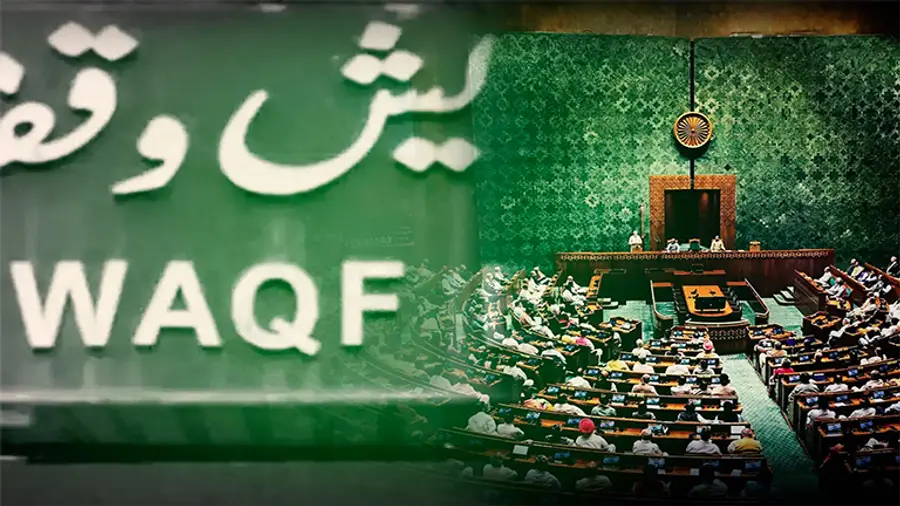
The Waqf (Amendment) Bill, 2025, was passed by both houses of Parliament—in the Lok Sabha with 288 votes in favour and 232 against, and in the Rajya Sabha with 128 votes for and 95 against—following intense debates. All amendments proposed by the opposition were rejected. Minority Affairs Minister Kiren Rijiju, defending the bill in the Rajya Sabha, stated that the amendments were made in consultation with various stakeholders and that all government bodies, including the Waqf Board, should reflect secular values. The government maintains that the bill aims to bring transparency, streamline administration, and strengthen dispute resolution mechanisms within Waqf institutions. However, the opposition and many civil society groups argue that it undermines the autonomy of Islamic religious endowments and opens the door to undue political and bureaucratic interference.
One of the most contentious aspects of the bill is the inclusion of non-Muslims on Waqf Boards, which has been justified by the government as a reflection of secular governance. However, critics argue that this provision violates the religious autonomy of the Muslim community, as Waqf properties are endowments under Islamic law meant to be managed by members of that faith. The absence of similar reforms for religious trusts of other communities further fuels allegations of selective secularism. The bill also introduces a centralised digital portal for managing Waqf properties, intended to reduce corruption and prevent unauthorised occupation. While digitisation could improve oversight, there are concerns that it could increase bureaucratic control and risk misuse of sensitive data, especially in the absence of stringent safeguards.
Another significant alteration is the reduction in the mandatory contribution that Waqf institutions must make to the Waqf Board—from 7 percent to 5 percent. Although this may provide financial relief to smaller institutions, it could also impair the functioning of already underfunded Waqf Boards unless alternative funding or efficiency measures are introduced. The bill restructures the functioning of Waqf tribunals by introducing fixed tenures and more formalised selection processes, which the government claims will lead to faster and more transparent dispute resolution. In a move to protect women’s rights, a new clause mandates that rightful female heirs—such as widows, divorcees, and orphans—must receive their inheritance before any property is declared as Waqf. While this is seen as a progressive step, its success hinges on effective enforcement and support mechanisms.
Institutions earning over 1 lakh rupees annually will now be subject to audits by state-appointed auditors, a move aimed at ensuring financial transparency. However, this has also raised fears of politicised or targeted audits. A particularly controversial provision allows senior officers, above the rank of collector, to investigate Waqf claims on government- owned properties. Critics warn that this could lead to the rollback of historical Waqf claims, particularly those located in high-value urban areas, through non-transparent and bureaucratic processes. The bill also restores a pre -2013 provision allowing Muslims who have been practising their faith for at least five years to dedicate property to Waqf, thus relaxing earlier restrictions and potentially encouraging new endowments.
While the government has portrayed the bill as a much -needed reform to bring efficiency, transparency, and gender justice, the broader political context cannot be ignored. The lack of community consultation, the top-down nature of the reforms, and the rejection of all opposition input contribute to the perception that this bill is more about control than reform. For many, it reflects an approach to governance that prioritises central authority and homogenisation over diversity and minority self-governance.
In its current form, the Waqf (Amendment) Bill, 2025 introduces several administrative changes that may improve efficiency, but it simultaneously risks eroding the religious and institutional autonomy of Muslim endowments. It raises critical questions about the balance between secular oversight and religious self-governance in a pluralistic democracy. Whether it will genuinely serve the interests of transparency and inclusion or further alienate and dis empower a religious minority remains a contentious and deeply divisive issue in contemporary India.



Related News
Dont Miss it










0 comments