
Emergency Editorial by Tharoor Shakes Congress

Web desk
Published on Jul 10, 2025, 01:22 PM | 4 min read
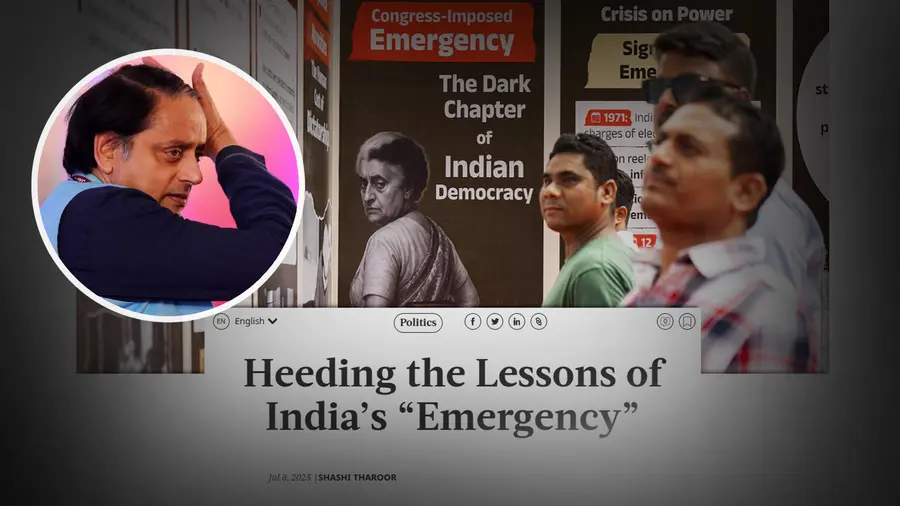
Shashi Tharoor’s article in Project Syndicate, marking the 50th anniversary of the Emergency, has ignited a political stir, not just for what it says about India’s past, but for what it signals about his political present and future. His critique of the Emergency is sharp, unambiguous, and largely grounded in historical fact. The suspension of civil liberties, press censorship, forced sterilisations, and authoritarian excesses of 1975–77 are well known. But when a senior MP from a party that has long avoided direct confrontation with that legacy calls it a time when “the soul of the republic” was lost, the timing and motive cannot be ignored. It raises a larger question: why now, and to what end?
“Sanjay Gandhi, the son of Indira Gandhi, led forced sterilisation campaigns which became a notorious example of this. In poor rural areas, violence and coercion were used to meet arbitrary targets. In cities like New Delhi, slums were mercilessly demolished and cleared. Thousands of people were rendered homeless. Their welfare was not taken into consideration,” Tharoor wrote.
For decades, the Congress has resisted fully reckoning with the Emergency. While occasional expressions of regret have surfaced, the party’s official position has largely been one of silence, deflection, or justification. Against this backdrop, Tharoor’s blunt criticism stands out, not simply as a personal reflection, but as a political signal. Publicly denouncing an era so deeply entwined with his party’s history hints at more than moral reckoning; it suggests a strategic attempt to distance himself from that legacy and craft a more autonomous political identity.
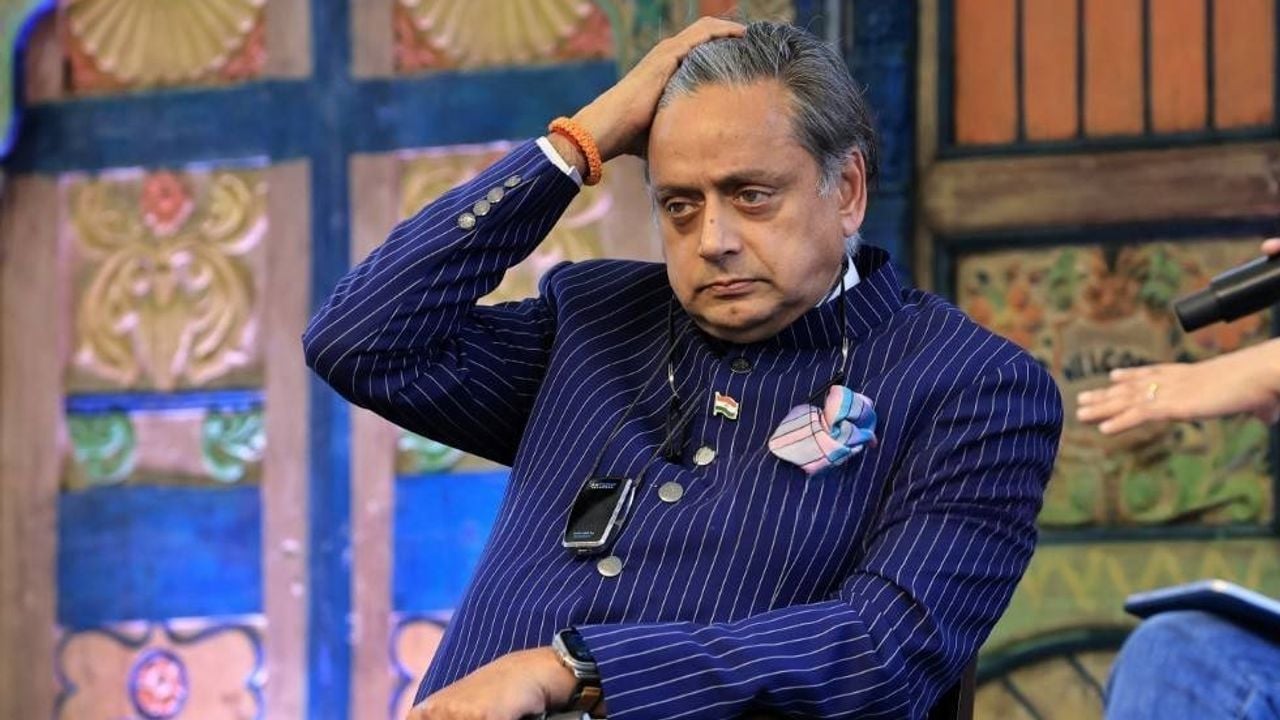 Shashi Tharoor Credit: AFP
This is not an isolated episode. Tharoor has steadily made statements that diverge from the party’s official line, praising Narendra Modi’s diplomacy, describing the 2016 surgical strikes as India’s “first,” and critiquing Indira Gandhi’s legacy on global platforms. These moves have elevated his individual profile while often placing the party on the defensive. Taken together, they suggest not ideological conviction, but deliberate positioning.
Speculation intensified recently when Tharoor amplified a dubious opinion poll claiming he was the most preferred Chief Ministerial candidate for the UDF in Kerala. Despite lacking methodological clarity or credibility, Tharoor shared the poll without caveat, an act many interpreted as self-promotion rather than confidence. In doing so, he bypassed the party’s internal mechanisms and presented himself as a presumptive leader in a race that hadn't officially begun. This not only sparked discontent within Kerala’s Congress ranks, but also raised concerns at the national level about his intentions and loyalties.
These actions beg a broader question: Is Tharoor preparing to exit the Congress framework? His increasingly unfiltered commentary, selective ideological alignment, and willingness to adopt narratives that appeal to broader nationalist or Modi- aligned audiences suggest a careful recalibration. Whether this results in a formal party switch, an independent path, or simply sustained ambiguity, remains to be seen. What is certain is that Tharoor no longer appears bound by party discipline or collective messaging. He is actively shaping a post- Congress persona, cosmopolitan, critical, and electorally nimble.
Figures like Tharoor are able to disown their own party’s past, rebrand themselves in real time, and keep multiple options open. The result is a political culture where opportunism is masked as conscience, and internal power struggles are reframed as moral awakenings.
“Let it serve as a lasting reminder to people everywhere,” Tharoor wrote, referring to the Emergency. “We are a more self-confident, more developed, and in many ways a stronger democracy. Yet, the lessons of the Emergency remain relevant in troubling ways.”
“Often, such tendencies may be justified in the name of national interest or stability. In this sense, the Emergency stands as a strong warning. The guardians of democracy must always remain vigilant,” he added.
Tharoor’s article is less an isolated moral reckoning and more a carefully timed entry in a broader project of political repositioning. His critiques may be historically accurate, but the context, delivery, and calculated ambiguity suggest a leader preparing for new terrain. Whether that means entering a rival camp, floating a new platform, or continuing as a wildcard with national aspirations, his trajectory reflects a wider reality of Indian politics: where principles often follow ambition, and memory bends easily to opportunity.



Related News
Dont Miss it





0 comments