
John Brittas Writes to Union Home Minister to Bring Shri Ram Janmbhoomi Teerth Kshetra Trust Under RTI, Cites Need for Transparency
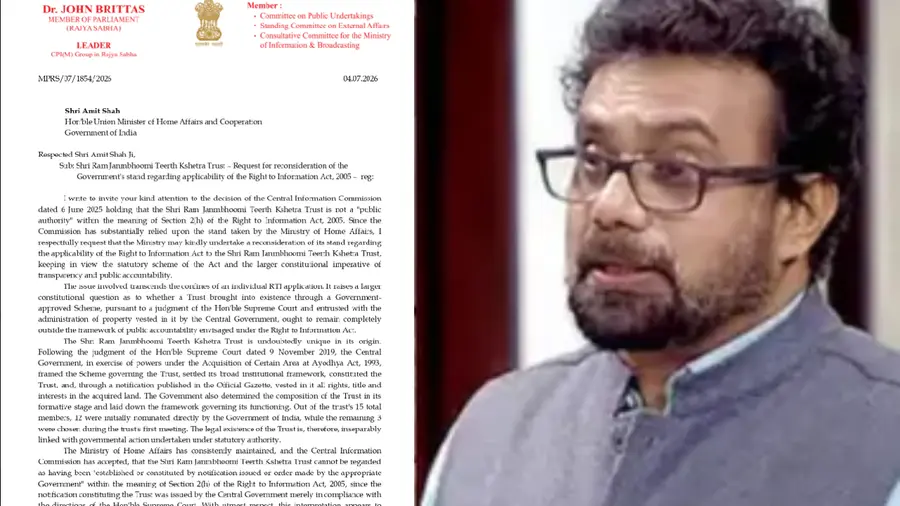
New Delhi: CPI(M) Rajya Sabha MP John Brittas has written to Union Home Minister Amit Shah urging the Centre to reconsider its stand that the Shri Ram Janmbhoomi Teerth Kshetra Trust is outside the purview of the Right to Information (RTI) Act, arguing that greater transparency is essential for an institution handling donations from millions of devotees. The letter was written following the allegations regarding the misappropriation of the donations to teh AyodhyaRam Temple under the trust.
On July 4, Brittas requested the Ministry of Home Affairs to review its position adopted before the Central Information Commission (CIC), which had ruled on June 6, 2025, that the Trust is not a "public authority" under Section 2(h) of the RTI Act.
Brittas argued that the Trust was constituted through a Government-approved scheme following the Supreme Court's November 9, 2019 judgment in the Ayodhya title dispute and derives its legal existence from governmental action under the Acquisition of Certain Area at Ayodhya Act, 1993. He maintained that the Central Government framed the scheme governing the trust, constituted the Trust, and transferred the acquired land to it through an official Gazette notification.
According to the CPI(M) leader, the Government's contention that the Trust was created only in compliance with a Supreme Court directive does not alter its legal status as a body established through a government notification. He argued that this aspect deserves fresh examination in light of the provisions of the RTI Act.
The Rajya Sabha MP also highlighted that the Trust's governing framework includes serving government officials, including nominees of the Central and Uttar Pradesh governments, as well as the District Magistrate of Ayodhya. He said this continuing institutional association reflects the Trust's public character and strengthens the case for greater accountability.
Brittas emphasized that the Trust administers one of the country's significant public institutions, manages land vested by the Central Government, and receives contributions from millions of devotees in India and abroad. The extraordinary confidence reposed by the public in the trust naturally carries with it an equally compelling expectation of transparency in matters concerning governance, financial administration, contracts, utilisation of donations and institutional decision-making. He argued that transparency in these administrative matters in no manner intrudes upon the religious autonomy of the trust; on the contrary, it enhances public confidence in its functioning.
Referring to Supreme Court judgments, including D.A.V. College Trust and Management Society v. Director of Public Instructions (2019) and Thalappalam Service Cooperative Bank Ltd. v. State of Kerala (2013), Brittas contended that the various criteria under Section 2(h) of the RTI Act operate independently. He also cited a recent Delhi High Court judgment holding the National Stock Exchange to be a public authority under the RTI Act, arguing that institutions deriving their legal existence from governmental action should be interpreted in favour of transparency.
Drawing comparisons with the Shri Mata Vaishno Devi Shrine Board, Brittas said institutional autonomy and public accountability can coexist, adding that bringing the Trust under the RTI Act would not interfere with its religious autonomy but would instead strengthen public confidence.
The MP requested the Home Ministry to reconsider its stand and pursue appropriate legal remedies before the jurisdictional High Court so that the question of the Trust's status under the RTI Act can receive an authoritative judicial determination.
Tags



Related News
Dont Miss it










0 comments