
India and Japan Sign Key Agreements Across AI, Defence and Economic Security at Annual Summit
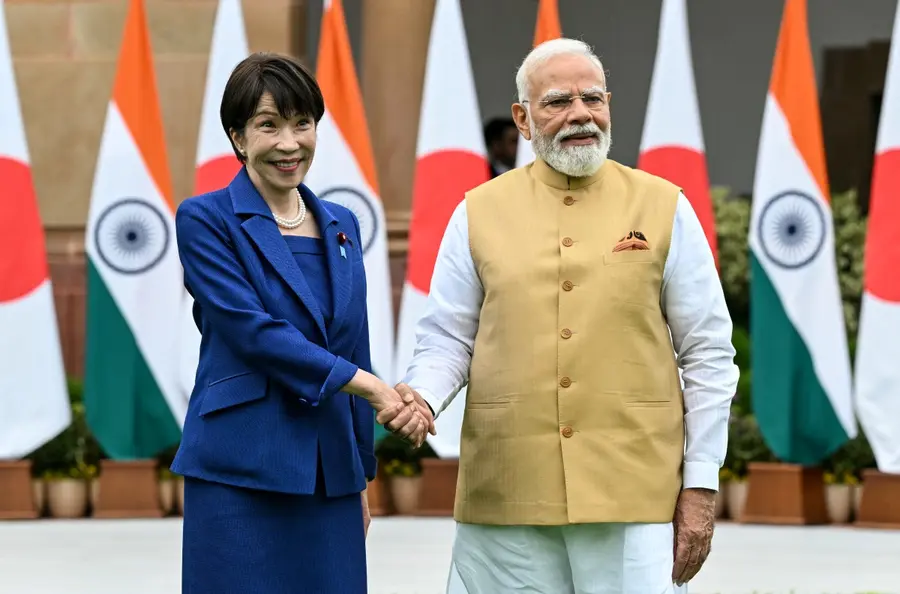
India's Prime Minister Narendra Modi (R) shakes hands with Japan's Prime Minister Sanae Takaichi before their meeting at the Hyderabad House in New Delhi on July 2, 2026. (Photo | AFP)
New Delhi: Amid growing global uncertainties, India and Japan have signed a series of significant agreements aimed at strengthening one of Asia's most strategic partnerships. The agreements cover a wide range of sectors, including artificial intelligence (AI), economic security, critical minerals, defence, healthcare, and energy.
The decisions were announced following talks between Prime Minister Narendra Modi and Japanese Prime Minister Sanae Takaichi during the 16th India–Japan Annual Summit held in New Delhi.
Prime Minister Modi welcomed Takaichi, Japan's first woman Prime Minister, on her first official visit to India since assuming office. He also highlighted her roots in Nara Prefecture, a region closely associated with the shared Buddhist heritage of India and Japan.
The two countries issued a joint statement on cooperation in artificial intelligence, while Indian AI companies signed agreements with Japanese partners. Prime Minister Modi said the combination of Japan's expertise in precision technology and India's software capabilities would provide fresh momentum to global AI development. Semiconductors, quantum technology, and secure supply chains also featured prominently in the leaders' discussions.
The summit also witnessed the launch of the first joint India–Japan defence development project. The two countries signed an agreement to jointly develop the Japanese Navy's advanced "Unicorn" radio antenna system. Modi said the project would open a new chapter in bilateral defence technology cooperation while strengthening maritime security and regional peace.
In the healthcare sector, both sides agreed to expand cooperation in pharmaceuticals, medical devices, and biotechnology. The partnership is expected to combine India's manufacturing capabilities with Japan's quality standards to deliver affordable healthcare solutions globally.
On the economic front, Prime Minister Modi said that nearly 120 new business agreements signed over the past year are expected to bring more than $10 billion in Japanese investment to India. The two countries also aim to double the number of Japanese companies operating in India over the next decade and attract investments worth one lakh crore yen from Japan.
As part of efforts to enhance energy security, the leaders announced the India–Japan Biogas Initiative, under which 1,000 biogas and organic fertiliser plants will be established across India. The initiative is expected to accelerate the country's transition to green energy while creating stronger livelihood opportunities in rural areas.
Both leaders reaffirmed their commitment to a free, prosperous, and rules-based Indo-Pacific region. They expressed confidence that the agreements reached at the summit would contribute to peace, stability, and sustainable development across the region.
The India–Japan partnership, once largely centred on infrastructure development and economic assistance, has evolved into a comprehensive strategic alliance increasingly focused on advanced technology, defence cooperation, and regional security.



Related News
Dont Miss it










0 comments