
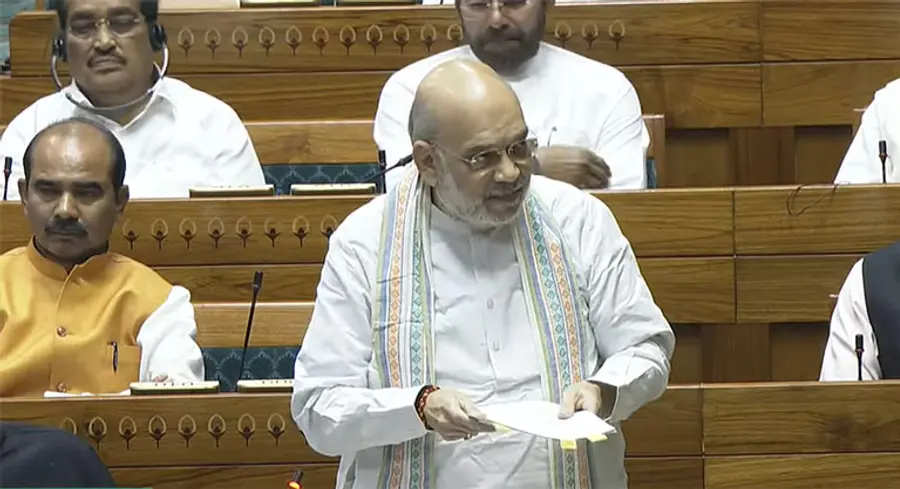
Amit Shah to Introduce Bills on Removal of Elected Leaders Facing Serious Charges

Web desk
Published on Aug 20, 2025, 11:12 AM | 3 min read
New Delhi: The government is set to introduce three bills in the Lok Sabha to allow the removal of the Prime Minister, Union Ministers, Chief Ministers, and ministers in states and union territories if they are arrested and detained in custody for 30 consecutive days for offences punishable with at least five years’ imprisonment. The bills include The Constitution (130th Amendment) Bill, 2025, The Government of Union Territories (Amendment) Bill, and The Jammu and Kashmir Reorganisation (Amendment) Bill, 2025.
While the government says the bills are aimed at strengthening accountability and protecting public trust, critics have raised concerns that the provisions could be used as a political tool against opposition parties. By allowing ministers to be removed automatically after 30 days of detention, the legislation could potentially be misused in a politically charged environment, particularly in cases where arrests are disputed or politically motivated.
The bills propose amendments to Articles 75, 164, and 239AA of the Constitution, empowering the President, Governors, and Lieutenant Governors to remove ministers based on arrest and detention. However, opposition leaders argue that concentrating removal powers in the hands of these authorities could lead to arbitrariness and political interference, undermining the principle of presumption of innocence.
Cases such as the arrests of former Delhi Chief Minister Arvind Kejriwal and Tamil Nadu Minister V Senthil Balaji have highlighted gaps in the current legal framework, where ministers continued in office despite serious criminal allegations. While the government maintains that the legislation is intended to uphold constitutional morality and good governance, opposition parties caution that the same provisions could be used selectively to target political rivals.
The bills also allow ministers to be reappointed after release from custody, raising concerns that the legislation may create a cycle of removal and reinstatement without addressing the underlying legal cases. Analysts warn that without clear safeguards, the move could politicize the offices of Governors and the President, especially in union territories and states with sensitive political dynamics.
A motion to refer the bills to a joint committee of Parliament for further scrutiny will also be moved in the Lok Sabha. The debate is expected to focus not only on governance and accountability but also on the potential political ramifications of the new legal framework.
The government has maintained that the bills are intended purely to ensure integrity in public office, stating that elected representatives “represent hopes and aspirations of the people” and should act above political interests. Critics, however, see the proposed legislation as a double-edged sword, capable of enhancing accountability on one hand while enabling political targeting on the other.
Related News
Tags



Related News
Dont Miss it










0 comments