
“Is It Anti-National to Demand Education For All?” — Ramadas Prini Sivanandan
Anjali Ganga
Published on Apr 23, 2025, 01:36 PM | 9 min read
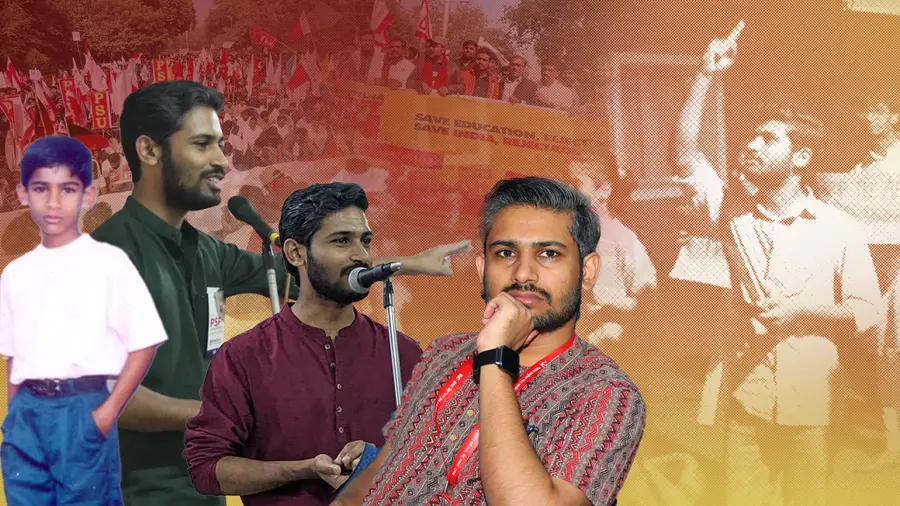
Ramadas Prini Sivanandan was just nine years old when his school, (Govt. LP School, Kalpetta), in Wayanad faced the threat of closure. The then-ruling United Democratic Front (UDF) government, led by the Congress, deemed it unprofitable—an expense they could dispense with. But for the students, most of whom came from working-class families of daily wage labourers and plantation workers, the school was their only hope.
For young Ramadas, the school wasn’t just a building—it was a lifeline.
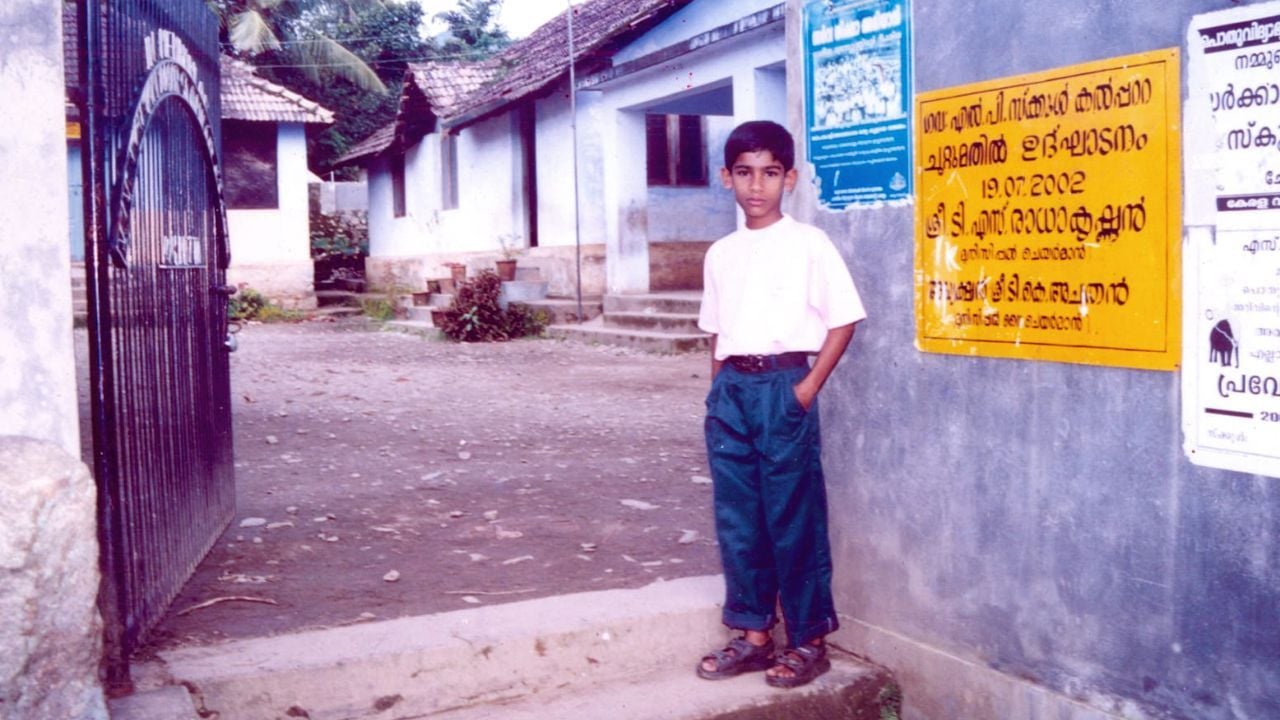 Ramadas in front of his school, Govt. LP School, Kalpetta
“I went to school not just for education, but also for the midday meal,” he recalls. “My parents hadn’t completed the 10th grade. I was the first in my family to pass it. No one in my extended family had cleared 12th grade—most were agriculture workers.”
When the closure was announced, Ramadas wrote a letter—to the President of India, Dr. A P J Abdul Kalam “I just explained why the school mattered,” he says.
The response was extraordinary. President Kalam intervened, instructing the Kerala government to keep the school open. Later, he met Ramadas in person. That moment etched a lesson into Ramadas’s conscience: silence is never the answer.
That same resolve carried him forward. He topped the TISS national entrance exam for his MA, earning a certificate from the administration. For his PhD, he aced both the entrance exam and interview. A UGC-NET scholar, National Fellowship recipient, and former General Secretary of the Progressive Students’ Forum (PSF), as well as a Central Committee Member of the Students Federation of India (SFI), Ramdas has built a life rooted in the legacy of Ayyankali—the Dalit reformer who fought for education as a right, not a privilege.
Two decades after saving his school with a letter to the President, that same unwavering commitment to justice has now cost Ramadas two years of his academic life at the Tata Institute of Social Sciences (TISS). A Dalit scholar and first-generation learner, Ramadas was suspended from TISS for participating in a peaceful protest and for sharing a Facebook post about Ram ke Naam, a documentary critical of communal politics.
Jantar Mantar Protest and Suspension
In June 2023, the central government announced a policy that brought all institutions receiving over 50% of their funding from it under direct administrative control. The governance model at TISS shifted dramatically. An Executive Council, appointed by the central government, replaced the previous structure. Key administrative positions were restructured, and a new tone of governance emerged—with Union Education Minister Dharmendra Pradhan assuming the role of Chairman of the TISS Society.
By early 2024, student unrest was growing across the country, fuelled by concerns over the National Education Policy (NEP). Sixteen student organisations, including the Progressive Students’ Forum (PSF), organised a protest at Jantar Mantar in Delhi. Ramadas joined the protest.
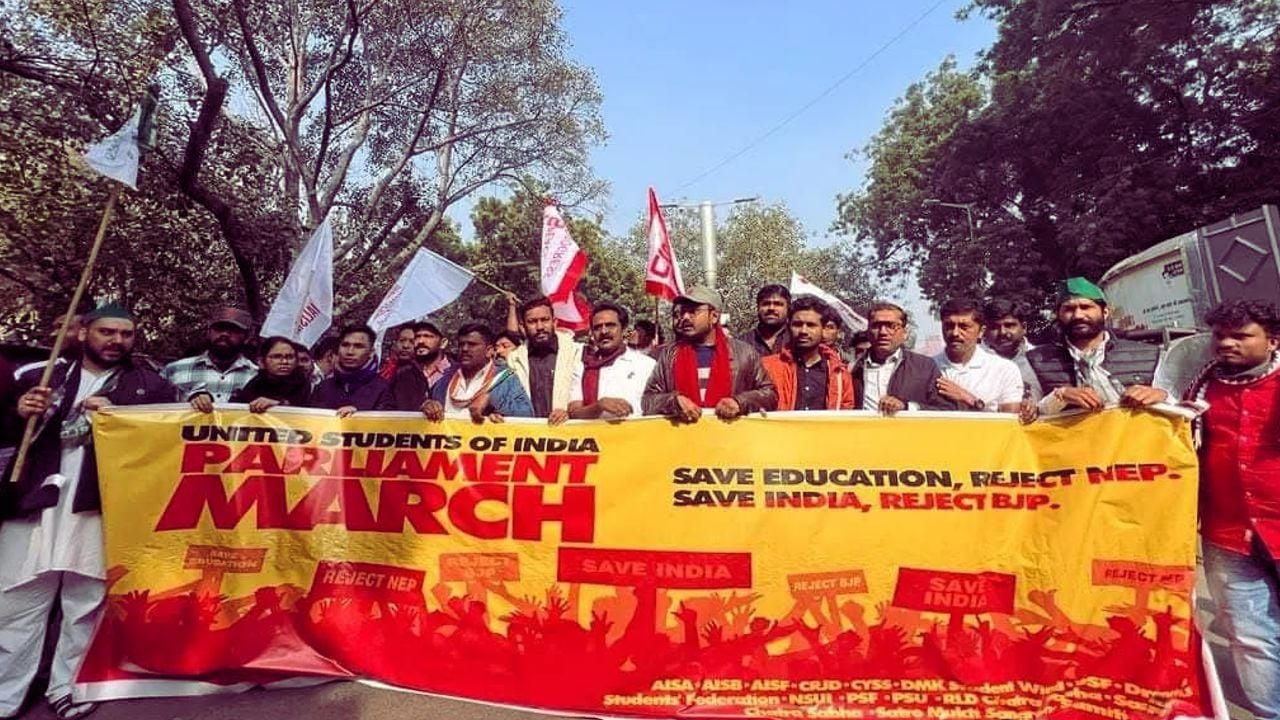 Ramadas, along with 16 other student organisations, during the march held at Jantar Mantar, Delhi
“The protest was peaceful, held in a legally sanctioned space, under full surveillance,” he says. “It was called a ‘Parliament March,’ but we didn’t even go near Parliament. Our slogans were simple: Save Education, Reject NEP. To me, that’s patriotic.”
TISS issued Ramadas a show-cause notice, accusing him of participating in the protest, distributing pamphlets, and organising a screening of Anand Patwardhan’s Ram ke Naam—an event, he says, that never happened.
“I was hospitalised after a bike accident on January 16,” Ramadas explains. “My leg was broken in five places. I was discharged only on January 25. Organising anything was physically impossible.”
He did, however, share a Facebook post during the Ram temple inauguration, encouraging people to watch Ram ke Naam. “It’s a nationally awarded film, once aired on Doordarshan, and still available on YouTube. It’s been screened on our campus multiple times. The filmmaker has even spoken at TISS.”
Despite this, the university’s statement falsely labeled Ram ke Naam as a “banned documentary.” “They were cyberbullying me,” Ramdas says. “They twisted my call to watch a historically relevant film into something sinister.”
The notice also referenced past instances of student activism, stitching together unrelated events to paint Ramadas as a repeat offender and a troublemaker.
“I joined the protest as a citizen of India,” he says. “I believe in dialogue, dissent, and education for all. That’s not a violation—it’s my right.”
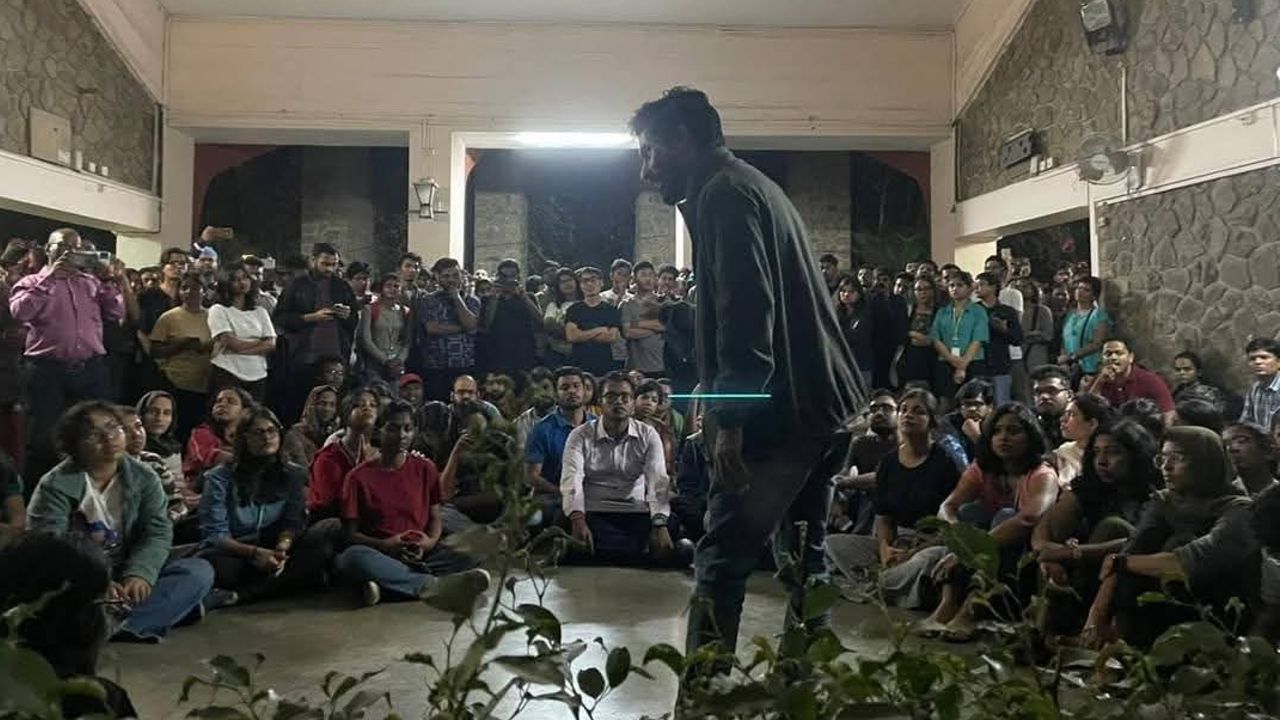 Ramadas addressing a student gathering
TISS further escalated the matter. The suspension order cited his Facebook post as “defiance of authority” and even suggested that whether he was “anti-national” should be left to law enforcement. Two days later, the university released a public statement labelling Ramadas “highly politically motivated” and accused him of “corrupting students’ minds.”
To Ramadas, it was clear: “This isn’t about misconduct. It’s about intolerance for critical thought.”
The Courtroom: A Battle for Justice
Even before Ramadas’s case was admitted in court, the Tata Institute of Social Sciences (TISS) took preemptive action: it banned the Progressive Students’ Forum (PSF) and introduced an “honour code” prohibiting protests and criticism of the establishment. However, student protests and public backlash forced the administration to revoke both measures.
Once the legal proceedings began, TISS adopted a punitive stance. In court, the institute went as far as to suggest Ramadas should be jailed for allegedly mobilising off-campus protests. As evidence, they submitted social media screenshots claiming he organized a screening of Ram ke Naam. The “proof” turned out to be a single, unattributed message: “Raam ke Naam is a good documentary. Kindly watch.” His legal team dismantled the argument: “How is this anti-national? Where’s the proof Ramadas sent it?”
Despite the weak evidence, the Bombay High Court upheld his suspension. Justices A. S. Chandurkar and M. M. Sathaye focused on an earlier pamphlet bearing the label “PSF TISS,” arguing that Ramadas’s protest participation created the perception of institutional association—bringing "shame" to the university. The verdict singled out three statements as problematic:
• “The RSS-backed BJP and the Sangh Parivar may escalate actions against minorities, secular, progressive, marginalised sections, and education policies.”
• “Save India, Reject BJP.”
The court ruled these statements too political for a National Fellowship recipient, implying that students receiving government funding should refrain from criticizing the ruling party. The judgement also endorsed TISS’s internal circular barring personal political opinions from being linked to the institute—setting a precedent that effectively subordinates student free speech to administrative authority.
Ramadas rejects the charge of misusing TISS’s name: “If ‘PSF TISS’ is objectionable, why do seven other campus groups, including the ABVP, use ‘TISS’ in their names? Why single us out?” No evidence tied him to the controversial pamphlets—the only exhibit was an unrelated, older flyer.
After his suspension, Ramadas’s fellowship was frozen. Though an interim court order restored it, the central government denied payments, citing his "inactive student" status. Eventually, the court allowed stipend renewal upon his professor’s approval—which was granted. However, they included a clawback clause: if the expulsion is upheld, Ramadas must repay all funds. “A fellowship isn’t charity,” he says. “I earned it by topping the NET-JRF. Stipends are remuneration—yet they are being weaponized to silence dissent.”

Justice Chandurkar, one of the judges in the case, came under public scrutiny for his contradictoRamadasry rulings. In June 2024, he upheld a hijab ban in a Mumbai college, reinforcing a controversial Karnataka verdict. Yet, in another judgment, he struck down the Centre’s 2023 amendment to the IT Rules—citing free speech concerns. These contrasting positions deepened the controversy surrounding Ramadas’s case.
Caste, Dissent, and Institutional Politics
Ramadas’s ordeal is far from isolated. In November 2024, Parliament raised questions about caste-based discrimination in higher education institutions. The central government and UGC responded by claiming they had no data. The court then instructed the UGC to collect reports from SC/ST cells and investigate pending cases—but the systemic issues remain unaddressed.
Institutional politics also surfaced in other troubling ways. During the Maharashtra state elections, TISS published a report alleging that illegal immigration by Rohingya and Bangladeshi Muslims was limiting job opportunities for Hindus in Mumbai. Despite lacking credible data, the report was widely used by the BJP in its campaign—raising concerns over the institute’s neutrality.
Similar clampdowns have occurred across Indian campuses. At Ambedkar University, IIT Madras, and Jamia Millia Islamia, student organizations were banned and activists suspended. At Jamia, the administration even posted protesters’ personal details on public notice boards. “This is a pattern,” Ramadas says. “Dissent is being crushed—and marginalized voices are the first to be targeted.”
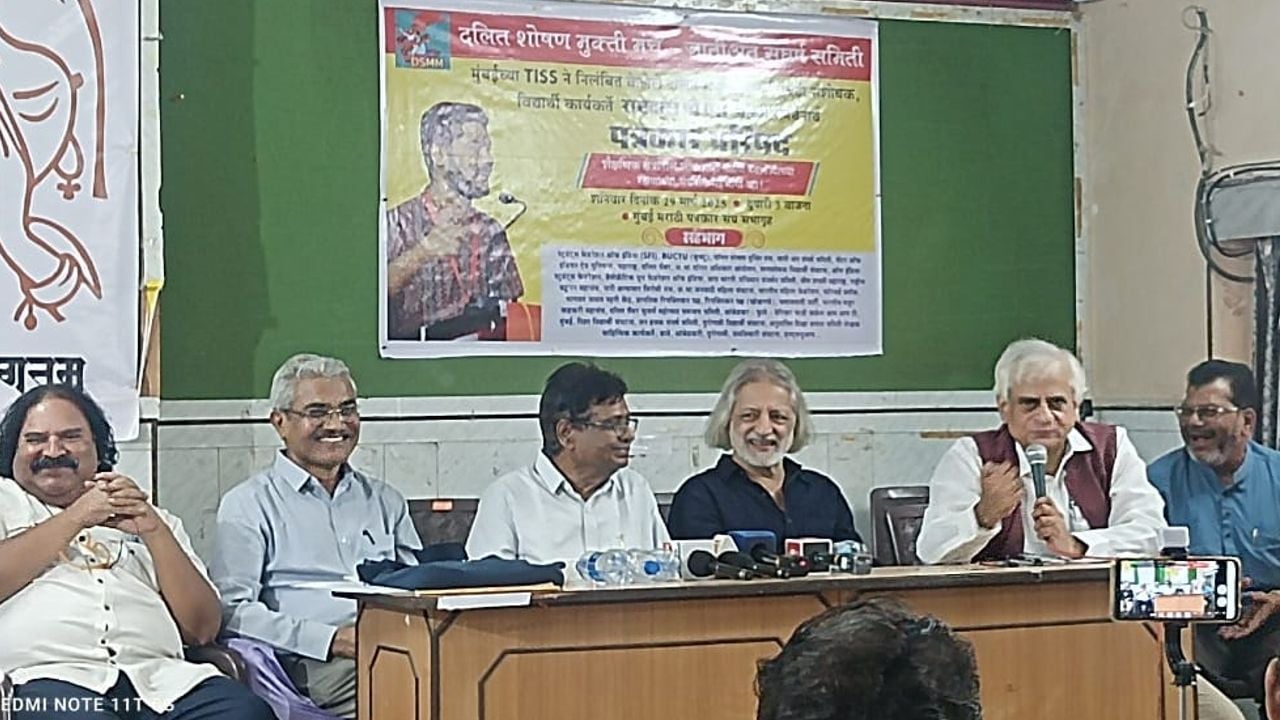 Renowned journalist P. Sainath speaking at a solidarity meeting organized by the Dalit Shoshan Mukti Manch (DSMM) and the Students' Federation of India (SFI), with filmmaker Anand Patwardhan beside him
Public response to Ramadas’s suspension was immediate and widespread. Alumni, student groups, and civil rights organizations rallied in his support, demanding that TISS revoke its decision. The Dalit Shoshan Mukti Manch (DSMM) and the SFI held a press conference in Mumbai to spotlight the injustice.
Renowned journalist P Sainath remarked, “The democratic space in educational institutions is being eliminated. Ramadas’s suspension is a prime example.”
, called the action unlawful: “The court said action should be taken against those preventing Ram ke Naam screenings. Instead, TISS suspended Ramadas for encouraging one.” Activist Arjun Dangle said, “Attacks on students and artists are rising. Cultural terrorism is on the rise.”
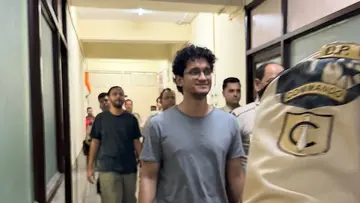
In response, SFI organized protests across 100 universities nationwide. On March 26, 2025, more than 350 individuals representing 16 human rights organizations gathered outside the TISS campus in Chembur, Mumbai, to protest the suspension. Among them were SFI General Secretary Mayukh Biswas and 50 others who were detained by police.
This was more than a protest—it was a collective reckoning. While the suspension sought to silence Ramadas on campus, it sparked a much larger conversation about academic freedom, caste, and dissent in India.
The Road Ahead: Supreme Court and Beyond
Following the Bombay High Court’s decision, Ramadas is preparing to take his case to the Supreme Court. While the verdict upheld TISS’s actions, it hasn’t dimmed his resolve.
“This isn’t just about me,” Ramadas says. “It’s about every student who dares to question. Every scholar from a marginalized background who’s told to stay silent.”
His journey—from a nine-year-old who saved his school with a letter to the President, to a PhD scholar challenging institutional power—is a testament to the belief that education is a right, not a privilege. Rooted in the legacy of Ayyankali, he continues to fight for dignity, justice, and the right to dissent.
This conversation is far from over. It’s too urgent, too persistent, and too courageous to be silenced. Ramadas’s voice—clear, principled, and unyielding—reminds us that the cost of speaking out is high, but the cost of silence is even higher.
Related News
Tags



Related News
Dont Miss it




0 comments