
Opposition to Jointly Resist Centre’s Delimitation Move in Pretext of Women’s Reservation
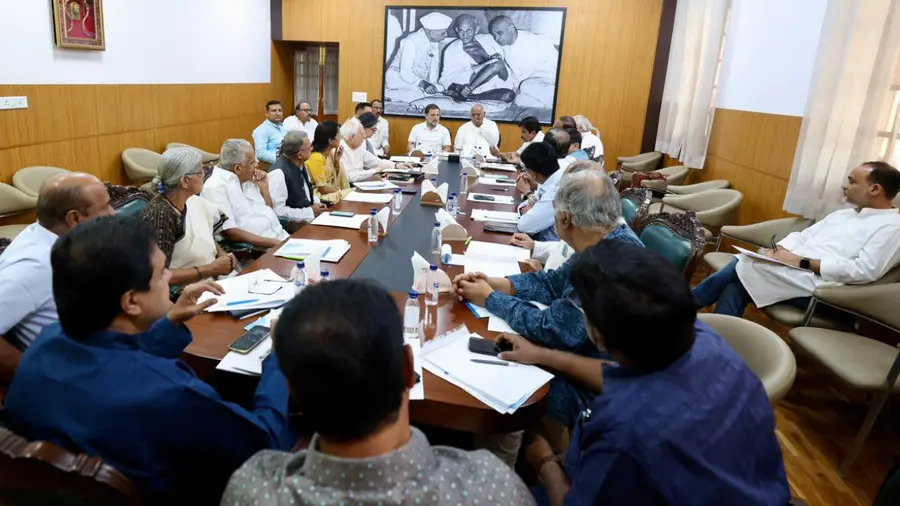
INDIA Bloc leaders
New Delhi: Opposition parties have decided to unitedly oppose what they describe as an “undemocratic move” by the central government to increase Lok Sabha and Assembly seats through delimitation based on outdated Census data, under the cover of women’s reservation.
While backing women’s reservation in principle, Congress president Mallikarjun Kharge said linking it to constituency delimitation is politically motivated. He asserted that the opposition would strongly resist the proposed constitutional amendment in Parliament.
A meeting held at Kharge’s residence was attended by several key leaders, including Rahul Gandhi, Tejashwi Yadav, Sanjay Raut, Annie Raja, Omar Abdullah, T. R. Baalu, Jose K. Mani, and N. K. Premachandran, among others.
The Centre is set to introduce key legislations in the upcoming Parliament session, including the Delimitation Bill–2026, the Union Territories Amendment Bill–2026, and the 131st Constitutional Amendment Bill–2026. Opposition leaders have criticized the government for not consulting state governments or opposition parties before bringing forward the proposals, noting that copies of the bills were shared with members only recently.
Concerns have been raised that the proposed delimitation could significantly reduce political representation for southern states. States like Uttar Pradesh and Bihar are expected to see a substantial increase in seats, while states such as Kerala and Tamil Nadu may face a relative decline in representation.
Although the Centre had earlier indicated in informal discussions that all states would receive proportionate increases, the current draft reportedly contains no such assurance.
Key Proposals in the Amendment
The 131st Constitutional Amendment Bill proposes increasing the strength of the Lok Sabha from 543 to 850 seats. Amendments to Article 81 would allow for 815 members from states and 35 from Union Territories (currently 19). Significant changes are also proposed to Article 82 related to delimitation.
The existing provision mandating delimitation based on the first Census after 2026 is proposed to be removed. This would enable delimitation to be conducted before the next Census, potentially using 2011 population data, with changes to the definition of “population” to facilitate this.
Opposition parties have announced that they will vote against the bills when they are taken up in Parliament.
Tags



Related News
Dont Miss it










0 comments