
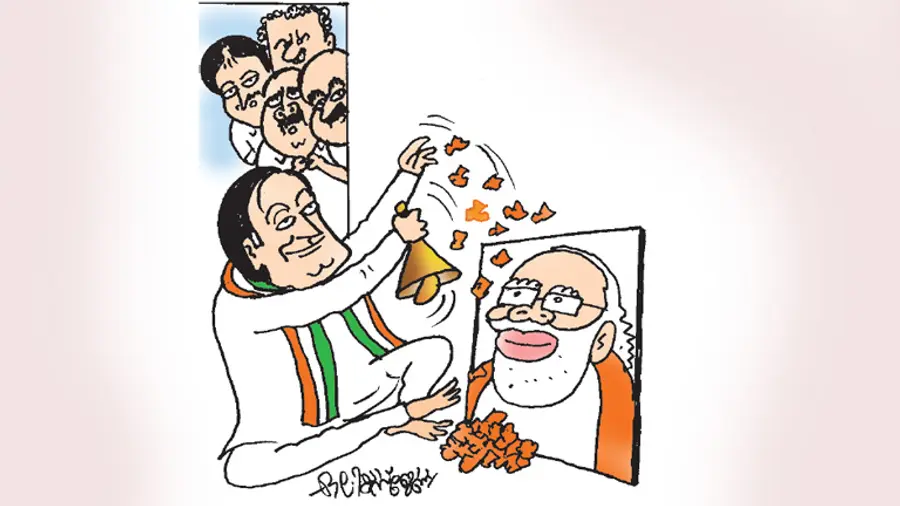
Modi is ‘Charismatic’, Emergency was a ‘Loss of Soul’: Tharoor Speaks, Congress Mute

Web desk
Published on Jul 12, 2025, 10:53 AM | 3 min read
New Delhi/Thiruvananthapuram: The Congress high command is facing mounting internal discomfort but continues to refrain from taking disciplinary action against senior leader and Congress Working Committee (CWC) member Shashi Tharoor, despite his repeated and increasingly bold deviations from the party’s line.
Tharoor’s recent remarks in London, where he described Prime Minister Narendra Modi as a “charismatic leader,” have deepened tensions within the party. Speaking at the “India 2047” seminar—an event closely aligned with the Modi administration—Tharoor openly praised the BJP government’s policy direction, declaring that India has “clearly moved away from the left-leaning ideology of the Congress” and is now benefiting from liberalisation and globalisation. He credited the Modi government with nurturing a stronger national consciousness and said that under Modi’s leadership, “nationalism has been given a strong framework,” implicitly suggesting it had surpassed the Congress’s own ideological narrative.
This speech came just a day after Tharoor ignited controversy through an article in Project Syndicate marking the 50th anniversary of the Emergency. In the piece, he launched a scathing attack on the Congress’s historical record, calling the 1975–77 Emergency period one in which “the soul of the republic was lost.” He criticised former Prime Minister Indira Gandhi and her son Sanjay Gandhi, citing the forced sterilisation drives and slum demolitions as examples of coercive authoritarianism. While Tharoor’s assessment was based on historical fact, his decision to voice it now—and so publicly—has been interpreted within the party as a deliberate move to distance himself from the Congress's legacy.
This is not an isolated case. In recent years, he has frequently made public statements that diverge from the party’s line—whether on foreign policy, military actions, or leadership issues. These repeated departures have caused discomfort among the leadership but have not been met with any concrete action.
The silence was especially stark after Tharoor shared an unverified opinion poll claiming he has the highest public support—and the most chances within Congress—for the Chief Minister’s post in Kerala. Seen by many as an act of self-promotion, this move bypassed the party’s internal decision-making processes and was perceived as a direct challenge to the state leadership. Although the poll lacked transparency or methodological clarity, Tharoor shared it without any caveat, drawing criticism both in Kerala and at the national level.
Within the party, only a few have publicly criticised him. Senior leader K Muraleedharan said, “Tharoor must first decide which party he belongs to,” while Leader of the Opposition VD Satheesan distanced himself, saying that since Tharoor is part of the CWC, only the national leadership can comment on the matter. Ramesh Chennithala, when asked about the survey, remarked vaguely that senior leaders should exercise restraint but avoided naming Tharoor. KPCC President K Sudhakaran offered a muted response: “As of now, Tharoor is still in the Congress.”
Tharoor, for his part, has made little effort to conceal his dissatisfaction with the party. He has openly stated that if Congress does not want him, he is willing to consider other political options. He has also criticised the Kerala state unit, saying there are “no real leaders” in the party. With local body elections approaching in Kerala and the assembly polls not far off, the Congress high command fears that acting against Tharoor now could further destabilise the party in the state, where it is already grappling with organisational challenges.
His strong showing in the AICC presidential race—where he finished second despite lacking organisational backing—has further complicated matters. Tharoor’s visibility among urban voters, his popularity on international platforms, and his consistent media presence make him a difficult figure for the leadership to ignore or isolate.



Related News
Dont Miss it





0 comments