
Kerala’s Education Reform: Building Futures from the Ground Up

Web desk
Published on Jul 15, 2025, 01:42 PM | 5 min read
Kerala is quietly leading a transformation in public education, with a series of bold reforms that prioritise inclusivity, innovation, and structural equity. The state’s approach is notably distinct from conventional education models across India, aiming to ensure that quality learning reaches every child, regardless of background or ability.
Among the most striking recent initiatives is the inclusion of robotics as a subject for Class 10 students. This step reflects Kerala’s commitment to preparing students for a future driven by technology and digital literacy. At the same time, the curriculum is being restructured to support differently abled children, with inclusive frameworks that make learning more accessible and engaging for all.
In an unprecedented move in Indian education, Kerala has introduced a dedicated textbook for parents. This resource is designed to help families better understand their children's academic journey and developmental needs. By empowering parents as educational partners, the state is strengthening the vital link between home and school.
The traditional model of school meals is also being revised, with Kerala now focusing on more diverse and nutritious options that cater to the health and cultural needs of all students. These changes are part of a broader transformation driven by the Department of General Education, aiming to build a learner- centric and responsive public education system.
These efforts are yielding tangible results. Public school enrolment in Kerala has been rising steadily, a trend that stands in contrast to declining numbers seen in other states. This increase reflects renewed public confidence in government schools, and it is a direct outcome of Kerala’s focus on quality, accessibility, and innovation.
Laying the ground work
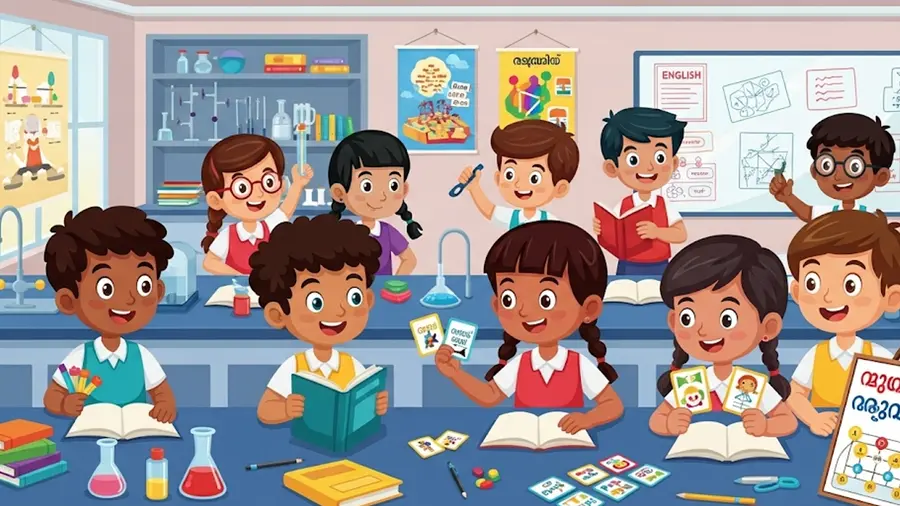
Pushing this vision further, the state is now launching classroom laboratories in selected public schools, targeting foundational learning years. Under the Samagra Shiksha Kerala, or SSK, STARs project, 100 government schools have been chosen in the first phase. These labs will serve students in Classes 3 and 4, focusing on four core subjects, the mother tongue, English, environmental studies, and mathematics.
Each school has been allocated Rs 50,000 to set up a lab, which will be equipped with over 150 educational tools. These include reading books, smart TVs, Bluetooth speakers, microscopes, telescopes, creativity walls to display student artwork, aquariums, puppets, number wheels, abacuses, rain gauges, and more. The aim is to provide hands-on, activity-based learning experiences that help students connect concepts to real-world applications.
What sets this initiative apart is its collaborative structure. Teaching and learning materials will be developed through joint efforts by students, teachers, parents, and Block Resource Centre functionaries. While some equipment may be procured externally, the emphasis remains on creating context-specific, textbook-linked content that is meaningful to learners.
According to SSK Project Director Dr A R Supriya, this model of classroom labs is the first of its kind in the country. The project is led by State Programme Officer Anulekha and STARs Consultant C Radhakrishnan Nair, and it aims to bridge the gap between textbooks and experiential learning at a crucial stage of a child’s education.
Kerala’s Education Reforms Face Financial Roadblock
However, Kerala’s progressive educational model faces a significant challenge. The Union Government has withheld Rs 15,000.27 crore in funds earmarked for the state’s public education system, citing Kerala’s refusal to implement the PM SHRI, or Pradhan Mantri Schools for Rising India, programme. These withheld funds include essential allocations for the SSK scheme and for the education of differently abled children.
During the financial year 2023 to 24, Kerala was supposed to receive Rs 513.54 crore under SSK, but the last two installments were not released, despite the state having completed all required documentation. The Centre is pressuring Kerala to convert 336 government schools into PM SHRI model schools, demanding that two schools per Block Resource Centre be brought under the scheme. A formal Memorandum of Understanding is required before any funds will be released.
Kerala has refused to sign the MoU, citing concerns about growing central control over education. The PM SHRI model is seen as closely tied to the National Education Policy, or NEP, which Kerala has not adopted. The state argues that the scheme promotes a selective upgrade of a few schools, creating inequality within the public system and weakening the educational rights of children in other schools.
Moreover, Kerala has raised alarm over ideological shifts in national education policy. Key historical and scientific topics, including Mughal history, the Gujarat riots, Darwin’s theory of evolution, and the assassination of Mahatma Gandhi, have been removed from NCERT textbooks. References to leaders like Maulana Abul Kalam Azad have been deleted, while narratives promoting a majoritarian view have been added.
This trend is seen as part of a larger project to impose a particular ideological vision on Indian education. Kerala opposes this shift, viewing it as an attempt to saffronise the curriculum, undermine historical accuracy, and erode constitutional values.
The NEP also includes provisions that encourage the privatisation of education, further raising concerns about equity. Preferential treatment of PM SHRI schools with enhanced infrastructure and visibility could drain students from regular public schools, leading to their slow decline. Kerala believes this approach contradicts the principle of universal, quality education for all.
Despite these pressures, Kerala continues to build a functional and inclusive alternative. Its emphasis on child-centred learning, community participation, scientific thinking, and democratic values marks a significant divergence from the Centre’s education model. In resisting ideological control and centralisation, Kerala is not simply opposing a scheme, it is defending the very foundation of equitable and autonomous public education in India.



Related News
Dont Miss it




0 comments