
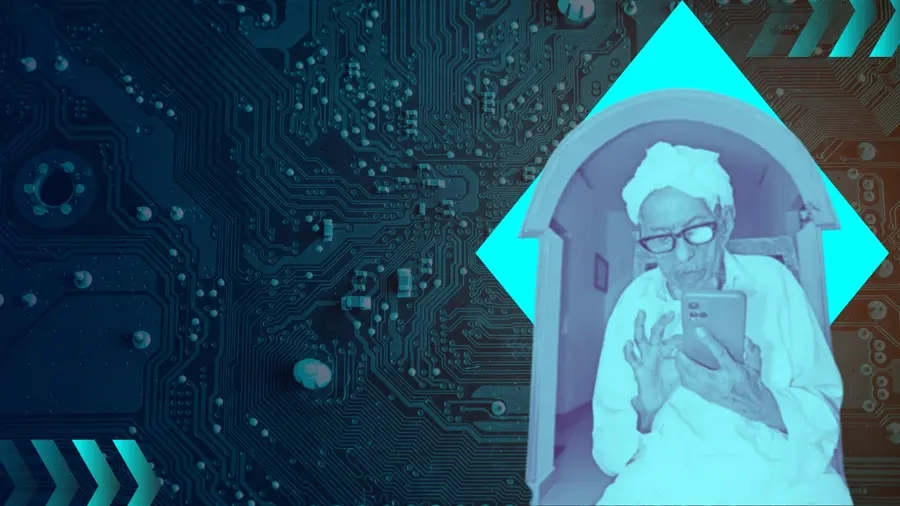
At 104, Kerala centenarian embraces smartphones, symbolising state’s digital leap

Web desk
Published on Aug 17, 2025, 12:03 PM | 4 min read
Thiruvananthapuram: Every morning in Asamannoor, Ernakulam, 104 -year -old M A Abdullah Moulavi begins his day in a way that would surprise many of his contemporaries. With frail fingers, he unlocks his son’s smartphone, scrolls through his favourite social media reels, finds prayer songs on YouTube, and even video -calls his grandson living abroad. The wrinkles on his face crease into a smile as he navigates the digital world with a confidence that belies his age.
Abdullah is not alone. He is among nearly 22 lakh people in Kerala who have stepped into the digital era through the state’s pioneering “Digi Keralam” programme, an initiative that has transformed the way people across generations connect, learn, and access services.
From senior citizens to daily wage workers, the programme has rewritten Kerala’s digital story. Take 79 -year -old Sarasu, who once resisted digital tools but now runs her own YouTube channel. Or 80 -year- old Sulochana from Moovattupuzha, who independently uses her mobile phone to access government services without leaning on others for help.
With an astounding 99.98 per cent of participants successfully acquiring basic digital skills, Kerala is now on the cusp of being officially declared the first digitally literate state in India. Chief Minister Pinarayi Vijayan will make the announcement on August 21 at the Central Stadium in Thiruvananthapuram.
The journey began in September 2022 when the Local Self- Government Department launched Digi Keralam, inspired by the historic total literacy campaign of 1991. The mission was simple yet ambitious: to identify digitally illiterate individuals and teach them the essentials, from switching on a smartphone to navigating e-governance portals.
“The immediate push came when government services moved entirely online,” said LSGD Minister M B Rajesh. “To ensure these services truly reached the people, we had to bridge the digital divide. That’s why we made digital literacy as much a priority as digitising the services themselves.”
In less than two years, over 21.8 lakh people were trained. Of them, more than 15,000 are aged above 90, stories like Abdullah’s standing out as proof that age is no barrier to learning.
Behind this feat lies the effort of over two lakh volunteers, students, Kudumbashree activists, NSS members, and police cadets, who travelled village to village, house to house. They taught people how to check bank balances, pay bills online, and stay connected with family, often overcoming resistance, poor connectivity, and limited resources.
The seeds of this statewide movement were sown in Pullampara, a small panchayat near Thiruvananthapuram. During the pandemic lockdown of 2021, villagers queued up at the only bank just to confirm whether their MGNREGA wages had been credited, often spending Rs 200-300 on transport for the trip. Watching this struggle convinced local authorities that digital literacy was not a luxury but a necessity.
Assistant Director Sajina Sathar, who spearheaded the Pullampara experiment, recalled, “The biggest challenge wasn’t teaching technology, it was convincing people that they could learn. Once the mindset changed, everything else followed.”
Pullampara went on to become Kerala’s first fully digitally literate panchayat in September 2022, prompting the state to replicate the model. What followed was a meticulously organised effort, master trainers, volunteer networks, online training sessions, and strong grassroots mobilisation.
For Abdullah’s son Faizal, the change in his father’s daily life is remarkable. “He now calls his grandson abroad by himself, or tunes in to YouTube for news. It gives him a sense of independence, and at this age, that means everything,” he said.
As Kerala stands ready to script history once again, Abdullah’s quiet pride over a smartphone screen tells the story best. The digital revolution here is not about technology alone,it is about dignity, inclusion, and the belief that learning never has an age limit.



Related News
Dont Miss it








0 comments