
Fearless in the Face of Fear: Deshabhimani and the Emergency

Web desk
Published on Jun 25, 2025, 11:42 AM | 4 min read
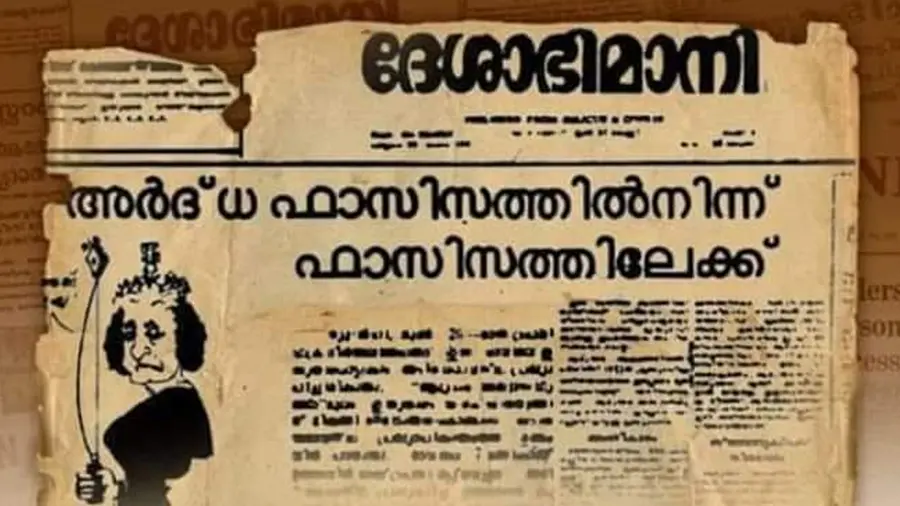
It has been fifty years since the dark shadow of the Emergency fell upon India, a time when truth was buried, facts were twisted, and fear ruled the nation. Yet, in the face of state repression and censorship, Deshabhimani stood out as a rare beacon of fearless journalism. It was the first newspaper to report in detail the declaration of the Emergency. Even under immense pressure, Deshabhimani, with the help of employees from the Postal and Telecom Departments, managed to bring the truth to the people.
While most newspapers of the time praised the Emergency and sang the praises of Indira Gandhi’s Congress regime, Deshabhimani alone dared to warn the public of its dangers. These were not just news reports, they were bold portrayals of one of the most horrific chapters in India’s democratic history. When the semi-fascist regime tried to silence the press, Deshabhimani refused to submit. It bravely exposed and criticised the government’s anti-people policies.
After the 1974 railway strike, a wave of protests and agitations erupted across various sectors, including against both state and central governments. In this climate of unrest, the Allahabad High Court delivered a landmark verdict declaring Prime Minister Indira Gandhi’s election invalid, a political bombshell. To cling to power and crush dissent, the government imposed a brutal "National Emergency" on June 25, 1975. For the next 21 months, India endured an era of darkness, fear, and repression.
At that time, Deshabhimani’s Delhi correspondent was Narikkutti Mohanan. Journalists who dared to report the truth risked imprisonment and police brutality. With no mobile phones or even STD lines, sharing news with Deshabhimani’s Kerala headquarters was a daring mission. Trunk calls were the only means of relatively quick communication, but using them could easily attract the attention of surveillance agencies. Recalling those challenging times is VAN Namboodiri, a national leader of the BSNL Employees Union.
Namboodiri was in Delhi when the Emergency was declared. A national convention of government employees’ federations was scheduled in New Delhi for the end of June 1975. He had travelled there as a delegate from Kozhikode.
“I arrived in Delhi on the morning of June 26. The New Delhi railway station was filled with police and CRPF forces. The people who had come to receive us informed us that the Emergency had been declared and that several opposition leaders had already been arrested. We were taken to the MP quarters of CPIM leader Jyotirmoy Basu, but he had already gone underground to avoid arrest. We were told not to step outside.”
Having visited Delhi several times before, Namboodiri was familiar with the city. Seeking more information, he went to the residence of AK Gopalan (AKG) on Ashoka Road. AKG was in Kerala due to ill health, but Namboodiri met Deshabhimani’s correspondent Narikkutti Mohanan there. Mohanan shared his struggles, he couldn’t send reports to Kerala, as trunk calls were blocked or under surveillance.
Just then, by sheer chance, K Prabhakaran, a leader in the Ernakulam Postal and Telegraph Department, called. Mohanan handed the phone to Namboodiri, who requested Prabhakaran to connect with the Deshabhimani office in Ernakulam. Through this unofficial network, Mohanan passed on crucial updates, including news of the arrest of opposition leaders. The next day, Deshabhimani published these reports in full, scooping every other Malayalam daily. That edition even carried a powerful cartoon of Prime Minister Indira Gandhi holding a sword.
The police interrogated Narikkutti Mohanan multiple times, trying to uncover how Deshabhimani got its information. But there were no trunk call records, no telegrams, and no written proof, so they had no case. Mohanan narrowly escaped arrest.
Indira Gandhi and the Congress government used authoritarian means to cling to power, even defying the judiciary. The Emergency plunged India into an unprecedented nightmare of fear and suppression. It remains one of the most horrific and shameful chapters in the history of Indian democracy, a time the country must never forget, and never repeat.



Related News
Dont Miss it




0 comments