
Again, Fights Erupt in Karnataka Congress: Leadership Crisis Deepens
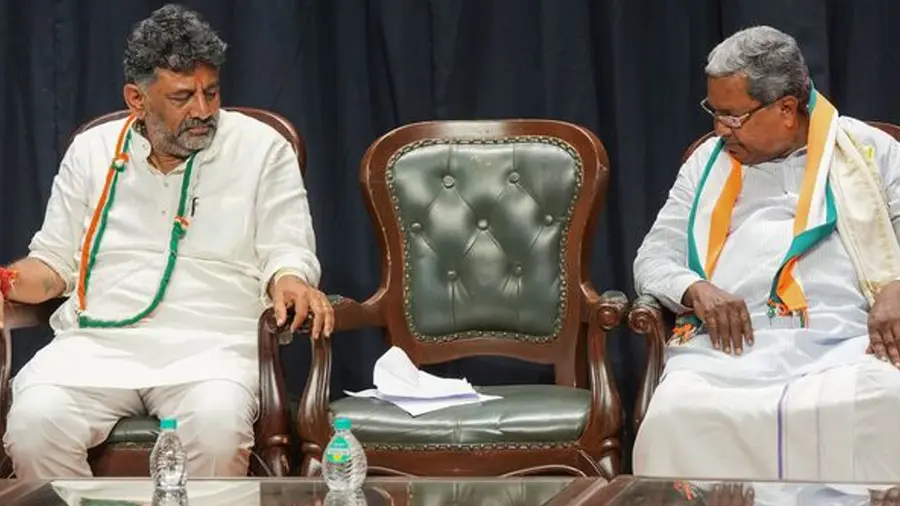
Karnataka CM Siddaramaiah and Karnataka Congress President D.K. Shivakumar (PTI)

Web desk
Published on Feb 18, 2025, 05:32 PM | 4 min read
The Karnataka Congress is once again in the headlines for all the wrong reasons. Internal clashes, factionalism, and a glaring lack of cohesive leadership have plunged the party into chaos, raising serious questions about its ability to govern the state effectively. Instead of focusing on developmental issues and policy implementation, the party appears consumed by power struggles, with leaders engaging in open confrontations that could have far-reaching political consequences.
Recent controversies—from senior leaders resigning to bitter public exchanges—have exposed the Congress’s deep internal rifts. As opposition parties watch closely, the internal turmoil in the Karnataka Congress could prove detrimental to its long-term stability, further eroding the confidence of both its supporters and the general electorate.
Rajanna vs. Shivakumar: A New Front Opens
The infighting within the Karnataka Congress took a dramatic turn on Monday when Cooperation Minister K.N. Rajanna launched a scathing attack on Deputy Chief Minister D.K. Shivakumar. Rajanna accused Shivakumar of “misusing” the name of the party’s high command, escalating the already tense relations between the two factions.
Rajanna’s comments came a day after Shivakumar urged his colleagues to stop “misusing” Chief Minister Siddaramaiah’s name. In a sharp retort, Rajanna said, “I agree that the chief minister’s name must not be misused, but this applies to those who are guilty of it. Did I build houses in Dollars Colony, Sadashivanagar, and Tumkur by misusing Chief Minister Siddaramaiah’s name?” This indirect reference to Shivakumar’s alleged property dealings added fuel to the fire.
Rajanna didn’t stop there. He continued his tirade, stating, “We should tell him not to misuse the name of the AICC and the party high command. Will the AICC speak about everything? If he takes some issue to them, they may issue directives. We follow those directives, but that’s a different matter. In politics, people misuse such things to their advantage.”
This public spat highlights the deep divisions within the party, with Rajanna, a close confidant of Siddaramaiah, openly challenging Shivakumar’s authority. Rajanna has been a vocal advocate for the ‘one person, one post’ norm, pushing for Shivakumar to step down as Karnataka Pradesh Congress Committee (KPCC) president.
The Never-Ending Power Struggle
At the heart of the Karnataka Congress’s turmoil is the relentless tussle between Chief Minister Siddaramaiah and Deputy Chief Minister D.K. Shivakumar. The two leaders, who have been at loggerheads for years, continue to engage in proxy battles, undermining the party’s stability. While Siddaramaiah represents the old guard of the Congress, Shivakumar, the state party chief, has been positioning himself as the face of the future. This power struggle has created a deep divide within the party, with loyalists of both leaders openly clashing over key decisions and appointments.
The recent resignation of senior MLA B.R. Patil as Siddaramaiah’s political adviser is a glaring example of this infighting. Patil, a veteran politician with a strong grassroots presence, was reportedly sidelined due to internal opposition within his district. Despite his aspirations for a ministerial role, he was relegated to an advisory position—a move that clearly did not sit well with him. His resignation has further exposed the factionalism within the party, with many viewing it as a direct consequence of the ongoing power struggle between Siddaramaiah and Shivakumar.
The proxy battles between Siddaramaiah and Shivakumar have not been limited to internal party dynamics. They have spilled over into public view, with both leaders using their respective loyalists to undermine each other. For instance, K.N. Rajanna, a senior Congress leader and MLC, recently slammed Shivakumar for allegedly misusing the names of top party brass to further his own agenda. Rajanna’s comments highlight the growing discontent within the party, with many leaders feeling sidelined or ignored due to the ongoing power struggle.
The infighting has also taken a toll on governance. Key policy decisions are often delayed or derailed due to disagreements between the two factions. This has led to a governance vacuum, with the electorate growing increasingly frustrated with the Congress’s inability to address their concerns



Related News
Dont Miss it








0 comments