
Yelahanka Demolition Drive Sparks ‘Bulldozer Raj’ Debate in Congress-Ruled Karnataka
In recent years, the term “Bulldozer Raj” has become synonymous with rapid, high-profile demolition drives in Uttar Pradesh, where the state government has been criticized for using heavy machinery as a tool to control the minorities.
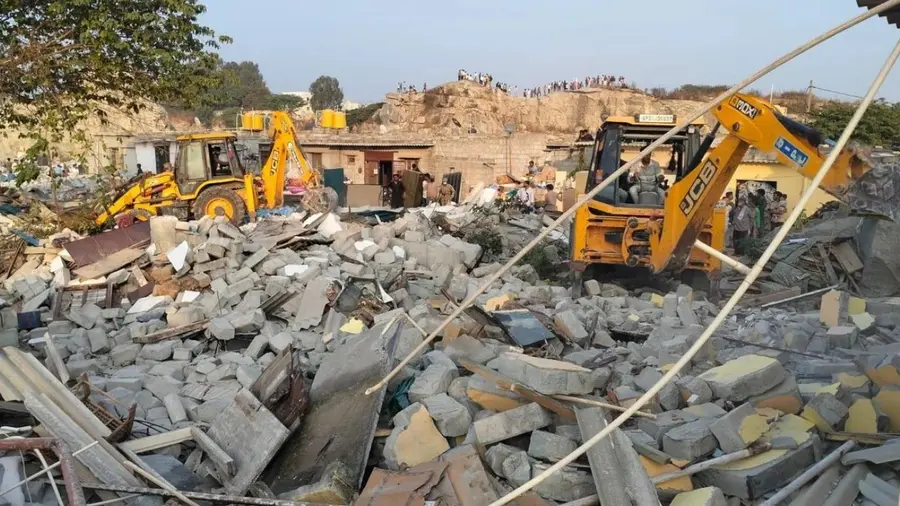
Now, a similar approach appears to be unfolding in Congress-governed Karnataka, particularly in the recent Yelahanka demolition drive. Over 300 homes in Fakir Colony and Waseem Layout were razed in a matter of hours, leaving hundreds of families — including pregnant women, children, and elderly residents — homeless. Although authorities framed the demolitions as a legal enforcement against encroachments, the lack of prior notice, rehabilitation, or social support echoes the same criticisms leveled against Uttar Pradesh’s Bulldozer Raj.
In the early hours of December 20, 2025, bulldozers and heavy machinery moved into Fakir Colony and Waseem Layout in Kogilu village near Yelahanka, north Bengaluru. The demolition drive left hundreds of families shocked, suddenly homeless, and struggling to cope with the loss of their homes.
What was meant to be a regular morning turned chaotic as officials from the Bengaluru Solid Waste Management Limited (BSWML), supported by police, began demolishing makeshift homes and small structures. Many residents reported receiving little to no prior warning and were forced to leave behind essential belongings, including documents and medical records, before their homes were destroyed.
The demolition affected over 300 houses, leaving hundreds of residents without homes. Many of those displaced were daily wage workers or small-scale business owners, whose livelihoods were disrupted overnight. Children, elderly residents, and pregnant women now face harsh winter conditions with limited access to basic amenities such as clean water, toilets, and food.
According to BSWML, demolition was carried out to remove illegal structures built on public property.
Residents told media like The News Minute that they had lived in the area for years, some for decades, and had documents such as electricity bills and identification cards to prove their residence. The eviction has interrupted education for children and destabilized the routines of families who had invested in building or repairing their homes over the years.
Authorities have stated that the demolitions were part of a clearance drive to reclaim government land, roughly five acres, intended for waste management and related infrastructure. Officials describe the operation as necessary to prevent encroachments and maintain public land.
However, residents dispute this, arguing that they were not given adequate notice, alternative housing, or rehabilitation plans. Many view the action as heavy-handed and insensitive toward marginalized communities, highlighting tensions between urban development and the rights of residents.
Following the demolitions, residents staged protests demanding immediate relief and long-term housing solutions. Activist groups joined them, calling for the authorities to take responsibility and provide urgent support. The state child protection commission also intervened, urging officials to arrange temporary shelter and ensure the welfare of displaced children and families. Karnataka State Minority Commission Chairman U Nisar Ahmed, who visited Fakeer Layout in Kogilu near Yelahanka on Wednesday, blamed Greater Bengaluru Authority (GBA) officials. He said GBA should have taken measures to prevent encroachment in the first place.
While authorities have periodically conducted drives against illegal constructions and encroachments, the Yelahanka demolitions stand out due to the scale of displacement and lack of immediate rehabilitation.
With their homes destroyed, affected families now face uncertain futures. Their immediate concerns—shelter, food, sanitation, and safety—remain pressing. As authorities emphasize legal compliance, these residents are left to navigate the challenges of sudden displacement and rebuild their lives from scratch.
In prioritizing land reclamation and bureaucratic mandates over the lived realities of marginalized communities, the Congress-led state government risks repeating the mistakes of its northern counterpart: alienating citizens, exacerbating social inequalities, and inviting legal and human rights scrutiny.
Left-wing organizations point out that there is a clear political motive behind these actions, which selectively target colonies inhabited by minority commuities and workers from the unorganised sector. what is being implemented by the Congress government in Karnataka now is the same kind of “selective bulldozer politics” that the Sangh Parivar practices in North India. The silence of ministers handling the Revenue and Housing departments reflects the government’s attitude towards the poor.
Left organisations such as Dhudiyuva Janara Vedhike have stepped in to provide food and temporary facilities to families who have lost their homes. The CPI(M) has demanded that permanent houses be immediately allotted to all affected families under the Rajiv Gandhi Housing Scheme, and that compensation be provided for the houses that were demolished.



Related News
Dont Miss it










0 comments