
A joke, a row, and a pattern: why Modi’s India is getting less funny
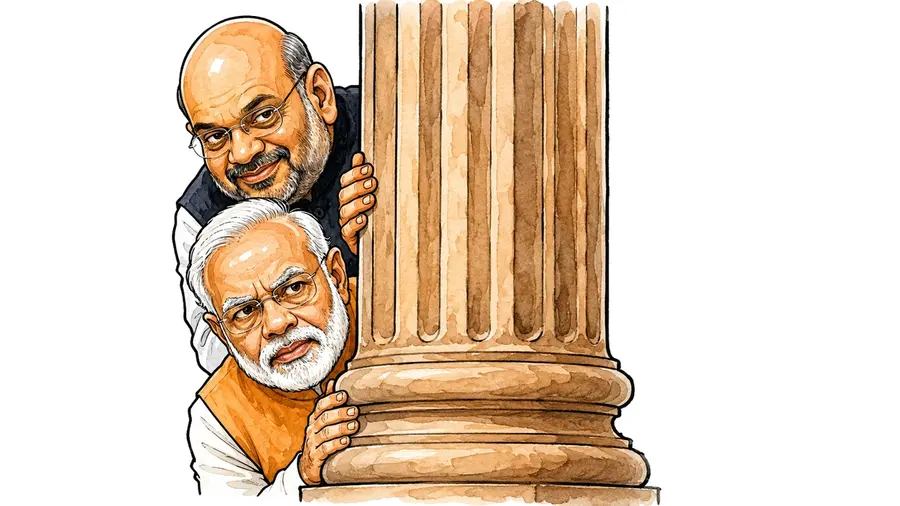
Image used for representation

Rahna Mariyam
Published on Sep 21, 2026, 10:19 PM | 5 min read
In the past week, stand-up comedian Pulkit Mani has become the latest flashpoint in a long-running debate over political satire in India: after mimicking Prime Minister Narendra Modi at a Congress event in Indore, he says three of his Uttar Pradesh shows were cancelled following “repeated threats from goon activists.” For critics, the episode is not an isolated controversy but part of a broader pattern in which the Modi government and its ecosystem respond to mockery with legal pressure, platform takedowns, and an atmosphere that makes satire increasingly risky.
The Pulkit Mani row: what happened
The immediate trigger was a skit at the Congress’s “Chhatron Ki Goonj” event in Indore on 20 September, where Mani shared the stage with Opposition leader Rahul Gandhi and performed a short mimicry of Modi’s mannerisms, diplomatic hugs, “my friend” phrase, and even referenced interactions involving an elderly woman and Modi’s late mother. The BJP reacted sharply, calling the act “vulgar,” “disgusting,” and an insult to mothers, and demanded an apology from Gandhi; Congress defended it as simple mimicry and satire.
Within hours, Mani announced on Instagram that his Noida show was cancelled due to “unforeseen circumstances,” followed by Lucknow and Kanpur shows called off over “repeated threats from goon activists.” He did not name who made the threats or whether police were involved, but the timing—right after a high-profile political backlash over mocking the Prime Minister—fed perceptions that the state and ruling-party ecosystem are intolerant of such humour.
A longer trail of cases against comedians
Mani’s situation sits alongside a string of legal and extra-legal troubles for Indian comedians in recent years, many of which critics link to the political climate under Modi. The most prominent example of professional fallout in recent years is Vir Das, whose "Two Indias" monologue at the Kennedy Center in Washington in November 2021 sparked a massive controversy. The routine, which talks about both sides of India, contrasted the India of "engineers and doctors" with the India of "farmers and labourers, "led to 14 police complaints against Das for allegedly insulting India on foreign soil. Es pecially, the part where he said," I come from an India where we worship women duringthe day and gang-rape them during the night." The consequences were severe and long-lasting.
Beyond the criticisms, he claims he is effectively "banned" in Madhya Pradesh, where state politicians made statements following the row that led him to avoid testing the waters. While no formal government restriction has been verified, the chilling effect is clear: a comedian who once toured freely now self-censors his movements within his own country. Das has also weighed in on other satire-related controversies, backing the "Cockroach Janta Party" satirical movement after its X account was suspended, calling the government's reaction an "utterly dumb move."
Munawar Faruqui, another comedian, was arrested in early 2021 over alleged jokes about Hindu deities, spending weeks in jail before securing bail; supporters framed it as punitive action for dissent, while authorities cited law-and-order and religious sensitivity. Pranit More, another stand-up, is now in the Supreme Court seeking to club multiple FIRs filed against him over the “Rs 370 biryani” controversy, with cases under the Bharatiya Nyaya Sanhita and the IT Act for alleged obscene content and public mischief.
Beyond arrests, comedians and satirical accounts have faced content takedown orders, police complaints, and social media bans for material seen as insulting the Prime Minister, BJP leaders, or Hindu sentiments.
Civil-liberty groups and international observers describe this as an “escalating crackdown” on satirists, arguing that the state increasingly uses criminal law and cyber statutes to discipline political humour.
The government’s defence: order, decency, and “misuse” of satire
Supporters of the government argue that the issue is not intolerance but the misuse of comedy to cross into obscenity, hate, or targeted harassment, especially around religion and national leaders. From this perspective, laws are applied to maintain public order and prevent content that could incite tension or offend communities. Comedians are not being singled out; anyone—activists, journalists, influencers—can face action if content is deemed unlawful.
Political satire is acceptable, but personal insults, especially involving family or deceased relatives, are seen as beyond the pale of legitimate humour. In the Pulkit Mani case, BJP leaders framed their outrage not as an attack on free speech but as a defence of decency and respect for the Prime Minister and his mother.
Why this matters for culture and journalism
For a culture beat and for writers tracking India’s public sphere, the stakes go beyond one comedian’s cancelled shows (or multiple shows). In any democracy, the ability to mock power is a key indicator of how open the system really is. When jokes about the "most powerful" figure invite legal risk or threats, the boundary of permissible speech shrinks.
Journalists and critics who rely on satire, cartoons, or ironic commentary to make points may start avoiding certain topics, narrowing the range of public debate.
The unresolved question
The Pulkit Mani episode does not, on its own, prove a centralized directive to “silence comedians.” But when stacked against past arrests, multi-state FIRs, takedown orders, and the rhetoric around “decency” and “insult,” it reinforces a narrative many artists and civil-liberty advocates already hold. Under Modi, mocking the Prime Minister is becoming an increasingly costly joke.
Whether that is “intolerance” or simply stricter enforcement of existing laws depends on one’s view of where satire ends and offence begins. What is harder to dispute is the practical outcome. More comedians are calculating risk before they write the punchlines, and some are deciding the laugh isn’t worth the trouble. On the political side, this increasing intolerance is "inspiring" otherpolitical leaders in the country. For instance, Keralam's Chief Minister V D Satheesan. In September, an satirical video of the CM was taken down from social media platforms. This action prompted online criticism amd discussions regarding political intolerance and censorship.



Related News
Dont Miss it




0 comments