
No MGNREGA, No Income: Workers in Bihar and Rajasthan Strike for Employment
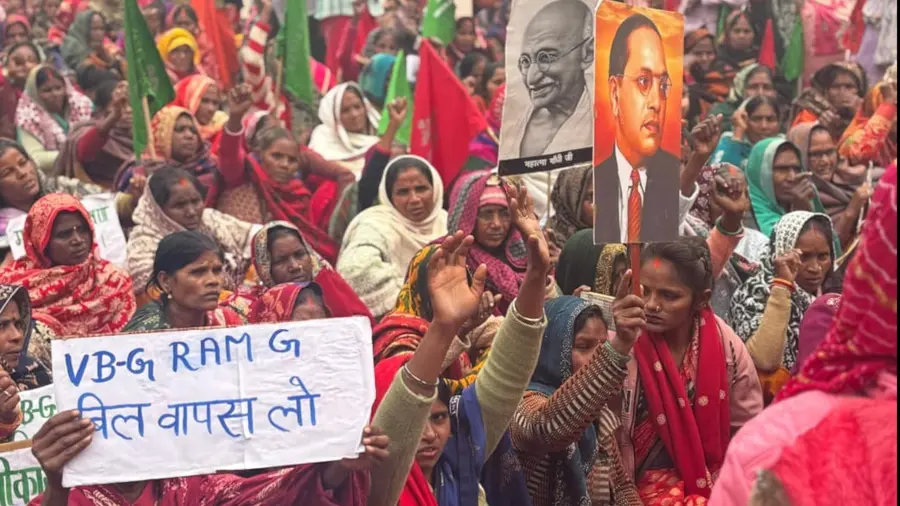
Protests Against the Dismantling of the Employment Guarantee Scheme
New Delhi: Unemployed and suffering, the workers under the National Rural Employment Guarantee Act (MGNREGA) in the country are facing a grave situation. Approximately 12,000 workers in the Muzaffarpur district of Bihar have not had any work for the last four months.
The central government is working towards introducing a new law to replace the MGNREGA. While the government assured that the current employment guarantee scheme would continue until the new law is fully implemented, the workers in Muzaffarpur have been protesting for 87 days. They claim that the reality is completely different from what is being promised. Workers still have no understanding of the new law and are uncertain about its implications.
The core issue is the absence of employment, as promised by the new law. There is still no clarity on whether the new law will replace MGNREGA or whether it will be implemented at all. The central government is in discussions with the states to formulate the necessary legal framework for this.
Typically, during the rainy season, MGNREGA work does not take place. By December, work usually begins again. However, workers are claiming that despite repeated requests, no work has been provided so far. About 16,000 workers in Muzaffarpur are protesting, most of whom are women. After receiving no response, a delegation traveled to Delhi on March 25 to meet senior officials from the Ministry of Rural Development.
No directive has been received regarding the commencement of work, and the reply from the district office was that no official notice has been issued. Sanjay Sahni, a representative from MGNREGA Watch-Bihar, has expressed concern over whether this is due to a lack of information or an unofficial directive from the central government to halt all work under MGNREGA.
This uncertainty is not confined to Bihar alone. Similar complaints have surfaced in the Dungarpur district of Rajasthan as well. In Balwarha Panchayat, on March 23, around 40 women workers came to complete the paperwork required for April's work but were sent back, being told that there was no clarity on the issue. Later, they were informed that the MGNREGA work had been suspended, and no further work under the scheme would be provided.
In Pachmarhi Mewar Panchayat, on the first week of April, around 30 women workers protested for about four hours, demanding work. Local officials initially claimed that there were instructions not to start any new work under MGNREGA. When workers refused to leave, higher-level officials arrived, and while their applications were finally accepted, there is still uncertainty about whether they will receive work.
For each family, MGNREGA provides an annual income of around 25,000 to 28,000 rupees. The situation is particularly tough for families where only women work, as they depend solely on MGNREGA and government pensions for their livelihood. Madhulika from the Rajasthan Asangathit Mazdoor Union says that this issue affects many tribal communities in the region.
The situation in Rajasthan's Beawar district is no different. On March 21, around 150 women workers from Rawatmal Gram Panchayat were informed that they could only be considered for work if they submitted a new application form according to the new law.
The MGNREGA scheme was introduced by the first UPA government, supported by the Left parties, to ensure universal employment rights. It provided a significant solution to rural unemployment. However, the new VB-G RAM G law seems to undermine the scheme’s framework and objectives. One of the key provisions of the new law is that it places the scheme completely under central government control.
The financial burden on the states has also increased, with the new law raising the state's share of the funding from 10% to 40%. The new law requires states to contribute 55,000 crores annually for a scheme that costs about 1.5 lakh crores a year. This would impose an additional burden of around 1,600 crore rupees per year on Kerala alone, which has been effectively implementing MGNREGA.
Around 14.5 crore workers across the country are currently engaged under MGNREGA. Farmers' and workers' unions are planning a nationwide strike on May 15 against the central government's efforts to dismantle the MGNREGA scheme. While the new VB-G RAM G law states that the current employment scheme will continue until the new law is implemented, many states have already started denying MGNREGA work to the workers before the new law has even come into effect, throwing them into a crisis.
Tags



Related News
Dont Miss it








0 comments