
Parliamentary Report Flags Delays, Budget Cuts in India’s Space Programme

Anjali Ganga
Published on Aug 13, 2025, 05:16 PM | 3 min read
New Delhi: A parliamentary review of India’s space programme has revealed persistent weaknesses in the Department of Space’s (DoS) planning and execution, despite headline figures showing high budget utilisation.
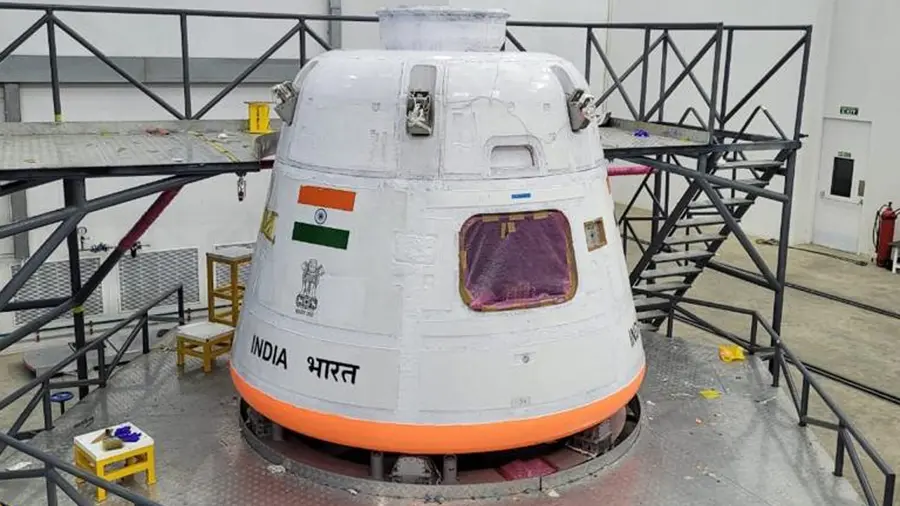
The 398th Action Taken Report, tabled in Parliament this month, shows that while the DoS spent 98% of its Revised Estimates for 2024–25, several high-profile projects faced steep mid-year budget cuts. Gaganyaan, India’s human spaceflight mission, lost over 350 crore rupees from its original allocation. The joint NASA-ISRO mission saw a 303 crore rupees reduction, and the Semi-Cryogenic Engine project was trimmed by 75 crore rupees.
The report highlights continued under utilisation in critical schemes, with Space Sciences achieving just 79% of its revised budget despite ongoing planetary missions like the Venus Orbiter and Chandrayaan-5. Communication satellite development under the INSAT programme also lagged.
While the government has “restored” funding for many of these schemes in the 2025–26 budget, the committee warns that these reversals may conceal deeper delays in hardware realisation, supply chain stability, and milestone completion.
The push to integrate private players through IN-SPACe and NSIL has made progress, but the DoS admits Indian industry still lacks the capability to build communication satellites, an obstacle to self-reliance goals.
The committee also flagged the absence of clear performance audits for NSIL, cautioning that without transparent oversight, public-private partnerships may not deliver maximum value.
Crucially, the report notes that DoS responses often rely on seeking extra funds at the Revised Estimate stage rather than addressing structural issues in financial forecasting, procurement, and project management.
With India aiming for deep-space missions, human spaceflight, and expanded private sector participation, the report warns that unless budget realism, milestone-linked disbursement, and stronger oversight are adopted, the country’s space ambitions could be slowed by recurring inefficiencies.
The Indian Science Congress, held annually for over a century, now faces an uncertain future. The Department of Science and Technology (DST) provides 5 crore rupees to the ISCA each year, a large share of which goes to the host institution to organise the five-day event.
The ISCA also secures funds from other government bodies and through member subscriptions. However, in September, the DST directed that government funds could not be used for the Congress. The ISCA challenged the order in court, alleging interference in its functioning, and the matter remains pending.
The funding freeze prompted Lucknow University, the original host for the 2024 Congress, to withdraw. Lovely Professional University stepped in but also pulled out last month, forcing the ISCA to place the 109th edition on indefinite hold. ISCA President Arvind Saxena said the association will appeal online for universities to host the event, with the aim of rescheduling it for February.
Related News



Related News
Dont Miss it








0 comments