
From Watchdog to Weapon: How the ED Became the BJP's Political Tool

Anjali Ganga
Published on May 23, 2025, 05:54 PM | 5 min read
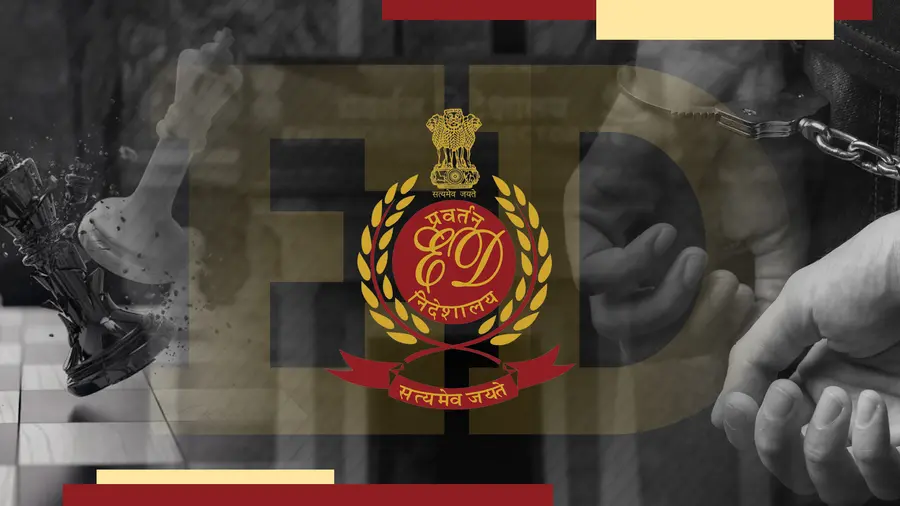
Thiruvananthapuram: In a democracy, institutions like the Enforcement Directorate (ED) are created to safeguard justice and financial integrity. Yet, in recent years, the ED appears to have drifted far from its constitutional mandate. Once regarded as a bulwark against economic crime, the agency is now increasingly viewed as a political weapon wielded by the BJP -led central government to suppress dissent, target opposition, and manipulate the democratic process.
Kerala: A Case Study in Selective Persecution
The recent arrest of ED Kochi unit Assistant Director Shekhar Kumar in a 2 crore rupees bribery case has put the agency under an unflattering spotlight. The Vigilance and Anti-Corruption Bureau (VACB) of Kerala named Kumar the prime accused after a cashew exporter from Kollam, Aneesh Babu, alleged he was coerced into paying a bribe to halt an ED probe. The trap led to the arrest of Kumar's alleged middleman Wilson Varghese and two others—Mukesh Kumar, a suspected hawala operator, and chartered accountant Ranjit Warrier. What was once India's frontline institution against financial crime now finds itself at the centre of it.
But this isn't just about personal corruption, it suggests a deeper institutional decay. The ED, entrusted with enforcing the law, appears to operate without internal accountability or external oversight.
Targeting KIIFB: A Political Vendetta
The agency’s focus on the Kerala Infrastructure Investment Fund Board (KIIFB) and the state’s former Finance Minister Dr. T M Thomas Isaac has also raised alarms. At issue is the issuance of Masala Bonds in 2019—a legitimate fundraising tool approved by the Reserve Bank of India (RBI) and used by central agencies as well.
Despite the bond being fully compliant with RBI regulations and audited monthly, the ED has repeatedly summoned Isaac. Its original 12-point demand even included personal records and information on his children—requests that were quietly dropped after legal scrutiny. The latest summons focus solely on how the funds were used, even though the matter is before the court.
Isaac has publicly denounced the ED’s tactics, asserting that the probe is not about financial impropriety but political intimidation. "If they clearly state the reason for summoning me, I will cooperate. But I will legally resist attempts to malign me with lies," he said.
Even the Kerala High Court has questioned the ED’s selective scrutiny, asking why similar investigations haven’t been launched into central agencies that issued Masala Bonds. No answer has been provided.
Meanwhile, the Comptroller and Auditor General (CAG) of India has slammed the Kerala government for "off-budget" borrowings through KIIFB and KSSPL. The report claims these borrowings inflated the state's actual debt burden to 38.23% of GSDP, far above the 34.5% target. The total liability is pegged at nearly 29,476 crore rupees, with 8,059 crore rupees borrowed in 2022-23 alone.
However, Finance Minister K N Balagopal has countered the CAG's claims, arguing that KIIFB borrowings are made with government guarantees and are, therefore, contingent liabilities, not direct debts. The state government maintains that these borrowings fund critical infrastructure and welfare pensions for over 60 lakh beneficiaries, and most of them are repaid within the fiscal year.
The CAG's findings are not new, they have been repeatedly discussed and dismissed by the State Assembly and Public Accounts Committee. But their timing, coinciding with ED's aggressive actions, fuels speculation of a coordinated attempt to discredit the state’s fiscal management.
A National Pattern of Political Targeting
Kerala is not alone. Across India, the ED's focus on opposition leaders, often during election cycles, suggests a calculated misuse of power. In the past ten years, the agency registered 193 cases against politicians. Of these, 138, over 70%, were filed after 2019, the year BJP returned to power for a second term.
Yet, only two convictions have been secured in this entire period. Both were from Jharkhand and date back to years -old cases involving local leaders. This 1 per cent conviction rate exposes the gap between arrests and actual judicial proof—an indictment of the ED’s credibility.
Congress spokesperson Supriya Shrinate summed up the opposition's frustration, calling the ED a "front" of the BJP. “As elections approach, the ED becomes the BJP’s blunt instrument of fear,” she said.
In Parliament, the Finance Ministry defended the agency, claiming it investigates based on evidence, not political affiliation. It also emphasised that the ED is answerable to multiple judicial forums. But the evidence suggests otherwise.
The ED’s credibility is now at a tipping point. Instead of upholding justice, it risks becoming a symbol of political coercion. The agency must be held to account—not just by courts, but by Parliament and civil society. Selective justice is not justice at all. If India’s democratic institutions are to endure, the ED must return to its original purpose: uncovering financial crime, not engineering political drama.If not, the agency’s fall from grace—evident in the Kochi bribery scandal and its dismal conviction record—will serve as a cautionary tale of what happens when the law becomes a weapon in the hands of power.
(To be continued)
Tags



Related News
Dont Miss it










0 comments