
Unmasking Propaganda: How Malayalam Media Passed Off a BJP WhatsApp Forward as a Central Government Order

Web desk
Published on Mar 05, 2025, 08:39 PM | 3 min read
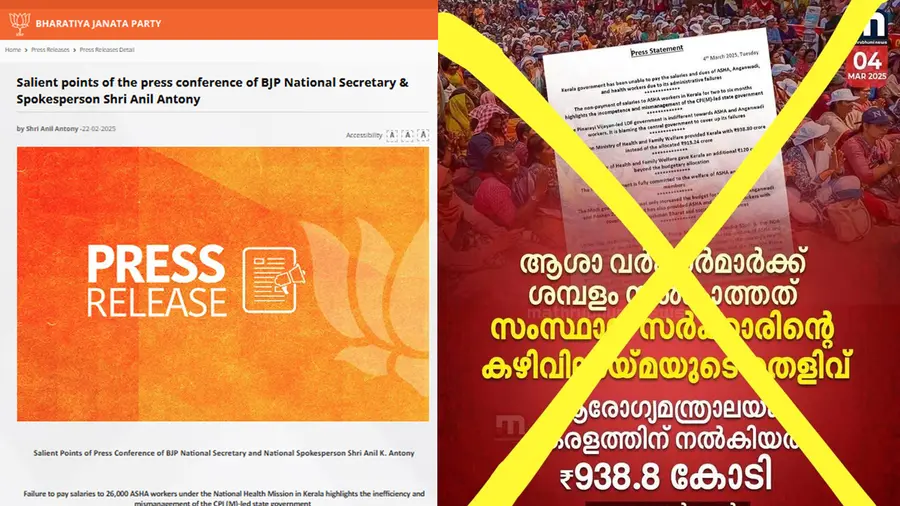
Today, controversy hit Kerala when an alleged press release—purportedly issued by the Union Health Ministry—accused the state government of failing to pay ASHA workers' salaries.Prominent Malayalam media outlets such as Manorama and Mathrubhumi reported that the central government had allocated Rs. 938.8 crore to Kerala and blamed the state administration for mismanagement by directly linking the non-payment of salaries to this negligence. In response to widespread media coverage, Kerala’s Health Minister Veena George swiftly refuted the claims in a detailed social media post, clarifying that the circulating document bore no resemblance to an official government release.
Senior journalist K J Jacob, upon noticing these inconsistencies, examined the release closely. His analysis revealed that its language deviated significantly from the formal tone typically employed by the Union Health Ministry—which customarily refers to the “Government of India” without mentioning specific political leadership. Instead, the contentious document made direct references to political entities and used terminology rarely found in genuine government communications. According to Jacob, a search of the Press Information Bureau and the Union Health Ministry’s official websites produced no evidence of the press release, further reinforcing the conclusion that it was not authentic.
Further investigation revealed that no such press release had been issued by the Union Health Ministry; instead, the document was traced to BJP National Secretary Anil Antony, who had published it on the party’s official website. Its content aimed to blame the Kerala government for alleged administrative failures—including the non-payment of ASHA workers’ salaries—by asserting that the state had misused or ineffectively utilized central funds. The timing and tone of the release suggested it was part of a broader political strategy designed to discredit the Kerala government while implicitly supporting the central administration.
Prominent voices in political and academic circles condemned the document for its misleading content. CPIM leader Dr. T.M. Thomas Isaac stated unequivocally in a Facebook post that the press release was "prepared from some of your centers to defame the Kerala Government and whitewash the Central Government." He clarified that the Rs. 920 crore mentioned represented the total financial assistance allocated for the National Health Mission, with only Rs. 59 crore earmarked for ASHA workers—roughly Rs. 1,800 per worker for about 26,000 workers. He further noted that the state was expected to contribute 40% of this total, along with a monthly honorarium of Rs. 7,000, despite there being no central mandate.
Experienced journalists can quickly identify multiple red flags in the document. Its language sharply diverged from the neutral, factual tone typical of official Union Health Ministry communications, instead employing overtly partisan rhetoric. This not only undermined its credibility but also appeared designed to defame the Kerala government by falsely attributing administrative incompetence. Ultimately, the evidence indicates that this was not a case of miscommunication but a deliberate attempt to misrepresent the government's performance.



Related News
Dont Miss it







0 comments