
Ice-Rock Avalanche, Not Earthquake, May Have Triggered Deadly Nepal Flash Floods, Scientists Say
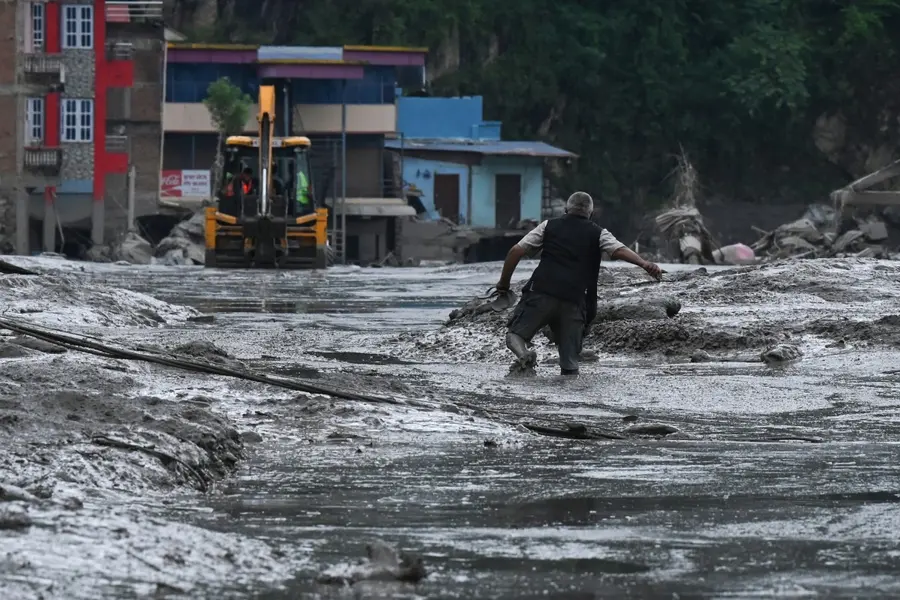
A resident walks along a street covered in mud following flash floods and a landslide disaster in Devighat, in Nepal's Nuwakot district on August 26, 2026. (Photo | AFP)
Kathmandu: Scientists have determined that a glacial collapse — not an earthquake as initially believed — triggered the catastrophic flash floods that killed over 160 people and left hundreds missing along the Nepal-Tibet border on Wednesday.
The US Geological Survey said seismic activity first reported as a magnitude 4.4 earthquake was later reassessed, after analysis of nearby seismic stations, long-period seismic waves and satellite imagery, as a magnitude 5.2 event caused by a glacial collapse and debris flow. "No earthquake had occurred," the agency said, adding that the collapse "caused subsequent catastrophic impacts downstream."
Researchers at the International Centre for Integrated Mountain Development (ICIMOD), working with partner institutions in Nepal and China, are separately investigating whether an ice-rock avalanche from high altitude set off the disaster. The Kathmandu-based intergovernmental body said preliminary video and field assessments suggest a large mass of ice and rock debris may have entered the Lende Khola, a tributary of the Bhote Koshi river, generating a surge of water, sediment and boulders that swept downstream through Nepal's Rasuwa district.
"The same site devastated by last year's Rasuwa flood is once again under threat," said Qianggong Zhang, ICIMOD's head of climate and environmental risks, warning that a blockage still lodged upstream near the Nepal-China border raised the risk of a second flood. Evacuation orders have been issued for Jilong port as a precaution.
Related News
ICIMOD noted the flood's unusual speed and scale, with water levels on the Trishuli river rising as much as nine metres within 30 minutes at Galchhi and seven metres at Malekhu, both in Dhading district near Kathmandu. Experts are also examining whether debris temporarily dammed a narrow stretch of the river, which could pose a further "secondary hazard" if the blocked water were released suddenly.
Nepal's Foreign Minister Shishir Khanal had earlier suggested an earthquake-triggered landslide was responsible, though that theory has since been superseded by the glacial collapse findings.



Related News
Dont Miss it








0 comments