
The 11th Party Congress and the Salkia Plenum

Research Desk
Published on Mar 27, 2025, 12:04 PM | 2 min read
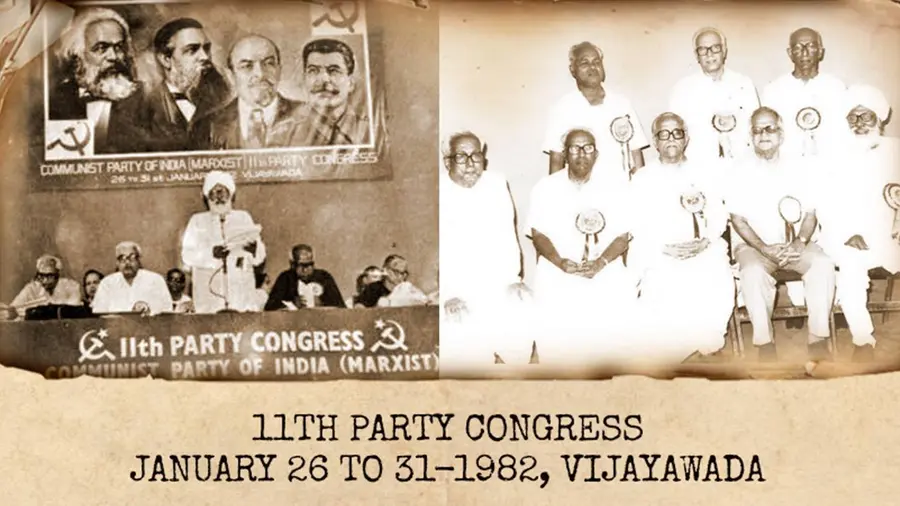
The 11th Party Congress was held in Vijayawada from January 26 to 31, 1982. The decisions of the 1980 October Central Committee and the Salkeya Plenum were subjected to detailed discussion. While presenting the Political Report, EMS emphasized the importance of the political organizational report and addressed the international, national, and economic contexts. The political organizational report was presented in two parts. The first part dealt with the national political situation and analyses discussed by the Party PB and the CC. The second part contained state reports related to organizational activities, class-mass organisations, and other related matters.
The report detailing the growth of the party after the 10th Congress highlighted that during this period, the party had risen to become the principal opposition in the country and had transformed into a party that the people looked upon with great hope. It elaborated on the functioning of the Party CC and PB after the Salkia Plenum. The report elaborated on the struggles for forming a left-democratic unity, building a broad-based front of resistance, the reasons for ideological differences within the Party, some of the Party's policies and political interventions, federalism, united actions, ideological actions, the work of the parliamentary group, Party center, brief details of PB-CC meetings, state reports, and the activities of workers', peasants', youth, and women's organizations.
The draft political resolution presented by B.T. Ranadive was divided into two parts: international conditions and national conditions. The first part addressed the contradictions between imperialist countries, internal conflicts within these countries, escalating tensions with the socialist camp, the looming threat of war, global hegemony, the struggles between third-world countries and imperialism, divisions within the socialist camp, and the weaknesses of foreign policies in socialist countries. The second part examined how the Indian economic structure, much like other third-world countries, had fallen victim to the destructive impact of global capitalism.
The growing dependency, Indira Gandhi's foreign policy, attacks on Left-wing governments, the resignation of the Kerala Cabinet, the successes of left-wing administrations, the third wave of divisive forces, Hindu communalism, Khalistan, and the unity of left parties were also addressed.
The Central Committee was finalized with 45 members, of which 42 were selected. EMS was elected as the General Secretary, and the Politburo (PB) consisted of nine members.
Related News



Related News
Dont Miss it




0 comments