
Thiruvananthapuram Hosts the Red Wave: The 13th Party Congress
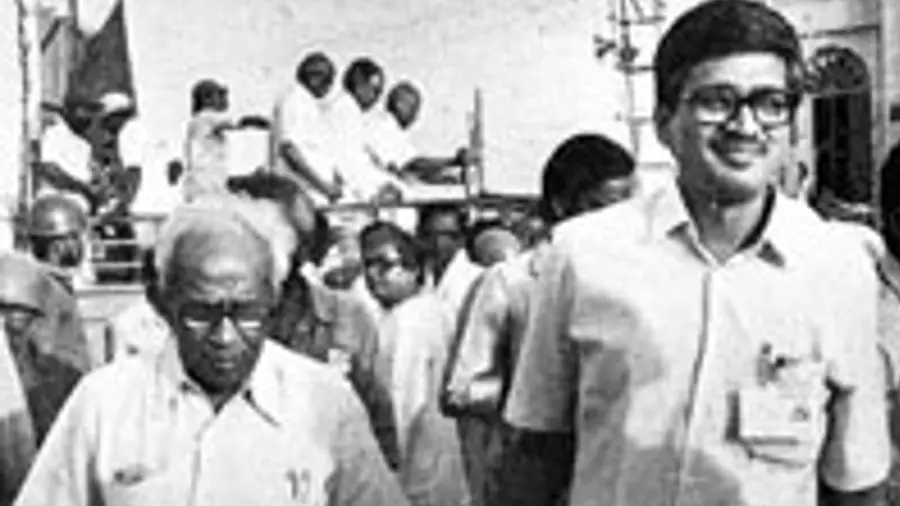
E.M.S. Namboodiripad with Young Karat

Research Desk
Published on Mar 28, 2025, 12:31 PM | 3 min read
The 13th Party Congress was held in Thiruvananthapuram, the capital of Kerala, marking the first time the city hosted the Party Congress and the third time the event took place in the state. The Congress was convened from December 27, 1988, to January 1, 1989, during the tenure of the Left Democratic Front (LDF) government. The General Secretary, E.M.S., inaugurated the Congress, while B.T. Randive presented the political resolution.
In the first section, titled "International Situation," it was assessed that despite various setbacks, there were certain positive changes on the international stage that favored the forces advocating for independence, democracy, peace, and socialism.
The "National Situation" section evaluated that post-independence India was confronting its most severe crisis, particularly in the agricultural and industrial-economic sectors. The analysis reviewed developments since the 12th Party Congress, focusing on the growing contradictions between the people and the ruling classes, the continuing economic crisis, and the plight of the masses burdened by these challenges. It also addressed authoritarian attacks, the intensifying communal tensions, issues in foreign policy, and the complexities of India-China relations, along with challenges related to Sri Lanka, Pakistan, and Bangladesh. Moreover, the report highlighted the rise of separatist and divisive forces, the policies of Congress(I), and the growing threat from communal and religious fundamentalism. Lastly, it underscored the importance of strengthening Left unity, the struggle to build the Left Democratic Front, and the Party's role in these endeavors.
The political-organizational report was structured in three parts. The first part addressed the international situation and national developments. The third part covered progress following the Salkia Plenary, struggles against federalism, issues related to growth, class and social structure, the composition of the working class, an evaluation of the functioning of state committee components, and matters concerning various organizations. EMS responded to the discussions on the report. The Party Congress approved the resolution assigning the Central Committee the responsibility for implementing the political-organizational report.
The Party Congress also approved proposed amendments to the Party Constitution. Under Article 15, Section 5, it was decided that a Secretariat should be elected from among the Central Committee members, with the number of members to be determined by the Central Committee itself. The amendment specified that the Secretariat's duties would include assisting the Polit Bureau in the daily operations of the Party Center and in the implementation of Central Committee decisions, in line with the Polit Bureau's guidelines. The Congress elected 66 members to the 70-member Central Committee, with the remaining four vacancies to be filled later. EMS was re-elected as General Secretary, and the Polit Bureau consisted of 12 members.
Related News



Related News
Dont Miss it




0 comments