
The First CPI(M) Party Congress in Unified Kerala: The Eighth Party Congress

Research Desk
Published on Mar 26, 2025, 02:12 PM | 3 min read
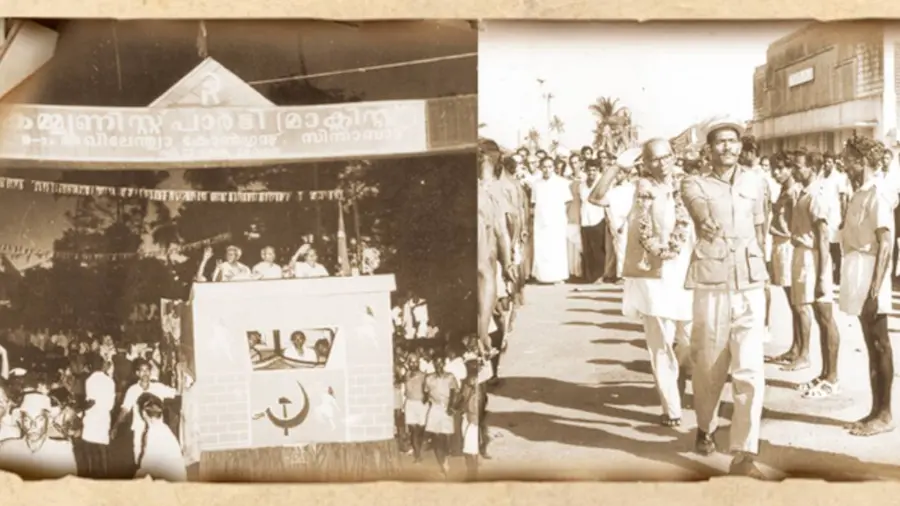
The first Party Congress after the formation of the CPI(M) was held in Kochi from December 23 to 29, 1968. This Eighth Party Congress holds the unique distinction of being the first in a unified Kerala. At the time, the United Front government, led by E.M.S., was in power. It was during this congress that the party formally adopted its constitution.
In the four years following the Seventh Party Congress, the Communist movement waged struggles against revisionism, and it is notable that these struggles aligned with the international fight against revisionism. This was highlighted in the detailed political-organizational report presented by B.T. Ranadive, which also emphasized that the Party's stance was to move forward in accordance with the theory and practice of Marxism-Leninism. Additionally, it provided a thorough analysis of both international and national political developments.
The section analyzing the national situation examined the nature and characteristics of the country’s economic crisis, identifying three key causes. The first was the contradictions between production and productive forces within the semi-feudal social order. The capitalist path of development, adopted as a solution, had instead worsened the crisis. This could not be dismissed as a mere temporary cyclical phenomenon or a case of inflation under capitalism. The report also addressed key topics, including the struggle against revisionists and the Party’s tasks, the class character of the country and national democracy, revisionists and socialist aid, and the failure of revisionist political tactics.
In the section evaluating the functioning of the Politburo and the Central Committee, the Party not only assessed its activities but also covered significant aspects such as the Bardhaman Plenum, setbacks due to the lack of left unity, directives for state committees, mass struggles, peasant movements, student fronts, Party publications, Party membership between 1964 and 1968, and the Party's relationship with mass organizations.
Political Resolution
The political resolution presented by M. Basavapunnayya highlighted the country’s deepening political and economic crises. It was structured into six sections: the evolving global situation and its new characteristics, India’s economic crisis and its underlying causes, the escalating political crisis and its significance, the struggles to build a united democratic movement and the Congress Party’s conspiracies to undermine it, the role of political parties and people’s struggles, and the Party’s responsibilities.
The sixth section highlighted the formation of United Front governments led by the CPI(M) in Kerala and Bengal as a major achievement. It also outlined key issues the Party needed to address across various sectors, seizing the opportunities created by the Congress Party’s setbacks. After 30 hours of extensive discussions, the Political Resolution was adopted with some amendments.
The Party Congress concluded with a Red Volunteer march and rally starting from the Deshabhimani Junction. Two lakh people participated in the march, while over five lakh attended the public meeting. Leaders P. Sundarayya, Basavapunnaiah, Jyoti Basu, Promode Das Gupta, EMS, and AKG greeted the crowds from an open lorry. The Party Congress elected a 28-member Central Committee, with P. Sundarayya as the General Secretary.
The Politburo consisted of nine members:
P. Sundarayya (General Secretary)
M. Basavapunnayya
P. Ramamurthy
Harkishan Singh Surjeet
Jyoti Basu
A.K.G.
E.M.S.
Pramod Das Gupta
B.T. Ranadive
Related News



Related News
Dont Miss it




0 comments