
The Ninth Party Congress: A Struggle Against Persecution

Research Desk
Published on Mar 26, 2025, 05:44 PM | 3 min read
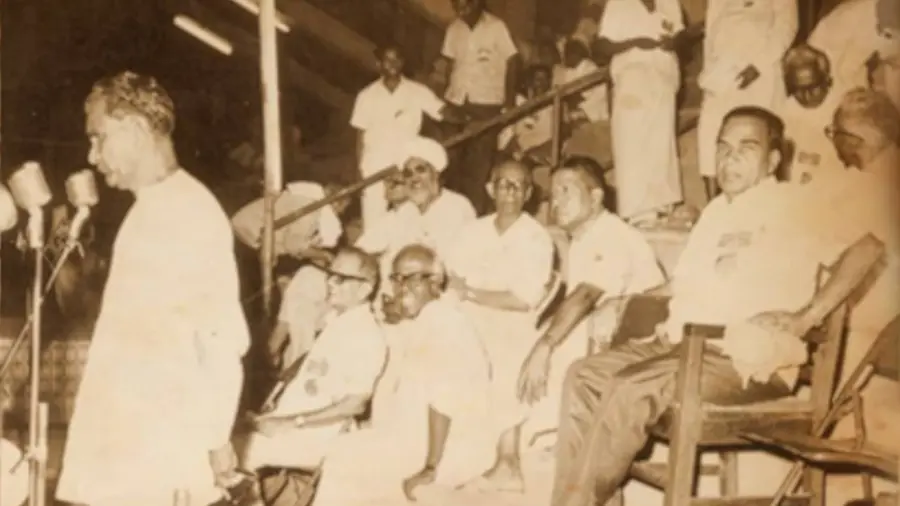
The Ninth Party Congress was held in Madurai from June 27 to July 2, 1972, at a time when left unity had significantly weakened at the national level, and CPI(M) workers across the country were being relentlessly targeted by political opponents and the ruling establishment. This was the second time in 18 years that Madurai became the venue for a Party Congress. Between March 1969 and June 1972, 656 comrades had been martyred in various states.
The draft political resolution, presented by B.T. Ranadive, emphasized in its opening section that the principal contradiction of this era remained the conflict between imperialism and the growing national liberation movements worldwide. It also addressed key developments such as the divisions within the socialist camp, the India-Pakistan war, and the liberation of Bangladesh.
The second section, titled The Specific Characteristics of the Present Situation, analyzed the breakdown of the Indian economy, the failure of the Fourth Five-Year Plan, the victory of Indira Gandhi-led Congress in the parliamentary elections, the achievements of the ruling Congress, the dangers of one-party dominance, the semi-fascist threat in West Bengal, the attempts to isolate organized movements, the Congress strategy to divide democratic forces, the tactical approaches of our Party, the betrayal of revisionists, the collapse of Left extremism, the growing mass struggles for unity against divisive tactics, and the ongoing struggle in West Bengal.
Harkishan Singh Surjeet presented a report on the changes that occurred during the discussions at the previous Party Congress. Basavapunnaiah introduced the Central Committee's note on the national question along with the amendments to the Party Programme. The amendments to the Party Programme were structured into nine sections. A policy declaration regarding the Party Programme was also presented.
The first section of the Political Organisational Report was titled Midterm Elections and United Front Governments. It dealt with the struggles surrounding the United Front governments in Kerala and West Bengal, the threats to overthrow both governments, and critically assessed whether the slogan "United Front of Left and Democratic Forces" remains valid.
The subsequent sections dealt with the split in the Congress party, elections, and the Bangladesh issue. The section titled The Collapse of Right Revisionism addressed how the right-wing Communist Party was gravitating toward bourgeois ideology and the disintegration of Left extremism. The last three sections focused on the international communist movement, tendencies of fragmentation and division, an assessment of the present situation, and the responsibilities before us.
The Congress adopted resolutions presented by Jyoti Basu on the semi-fascist terror in West Bengal and the nationwide repression, as well as by P. Ramamurti on securing workers' freedom to organize and struggle.
A detailed discussion took place on the note presented by M. Basavapunnaiah regarding the national question in India. The Party concluded that the national question must be analyzed in the context of India’s specific conditions and through the perspective of Marxism-Leninism. It was emphasized that while the Party must strongly stand for the self-governance, rights, and powers of the states and oppose all forms of repression, it must also remain vigilant against those who exploit national sentiments to create anarchy and attempt to disrupt the unity of the working class and the nation.
The Party Congress elected a 31-member Central Committee and P. Sundarayya as the General Secretary.
A nine-member Politburo was also elected:
P. Sundarayya (General Secretary)
M. Basavapunnaiah
P. Ramamurthi
Harkishan Singh Surjeet
Jyoti Basu
A.K. Gopalan
E.M.S. Namboodiripad
Promode Dasgupta
B.T. Ranadive
Related News



Related News
Dont Miss it




0 comments