
Mass Graves, Missing Women, and a Whistleblower: The Dharmasthala Horror Unfolds
Anjali Ganga
Published on Jul 16, 2025, 05:42 PM | 6 min read
“I had to bury hundreds of bodies of women and children from 1998 to 2014 when I worked as a sanitation worker in Dharmasthala.”
This haunting confession by a former sanitation worker has sent shockwaves across Karnataka and beyond. His testimony, given in a Beltangady court on July 11 under Section 183 of the Bharatiya Nagarik Suraksha Sanhita (BNSS), has reopened deep wounds and sparked fresh outrage over long-standing allegations tied to the Dharmasthala temple complex. Appearing before the magistrate with a human skeleton in hand, the whistleblower urged authorities to visit the sites where he says bodies were buried, the remains of countless women and children who were brutally assaulted and murdered, then discarded in mass graves.
According to his statement, these atrocities were carried out over a span of 16 years, beginning in the late 1990s. He claimed many of the victims were schoolgirls in uniform, women showing signs of sexual violence, or those who had been disfigured in acid attacks. “They threatened to kill me too if I didn’t dig the graves. I just want to sleep peacefully for one night,” he told media. He added that anyone who resisted or protested the violence met the same fate.
He initially believed some bodies were suicides pulled from the Nethravathi River. But he later realized many were murder victims, killed within or around Dharmasthala and buried to silence any trace of the crimes. The worker left his job in 2014, he says, after his own relatives were sexually assaulted by people associated with the temple. Since then, he has lived with guilt and fear, until now.
A Missing Daughter, A Silenced Mother
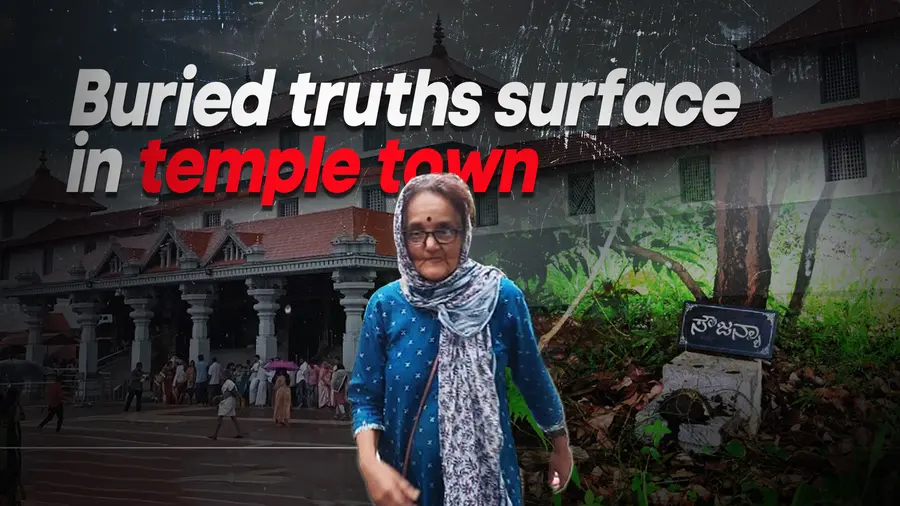
The revelations have brought new attention to old, unresolved cases, including that of Ananya Bhatt, a young medical student from Manipal who vanished in 2003 after visiting Dharmasthala. Her mother, Sujata Bhatt, a stenographer working with the CBI at the time, was in Kolkata when her daughter’s friend Rashmi informed her that Ananya had been missing from her trip to Dharmsthala. And warden informed Sujata that Ananya was missing from hostel for three days.
Sujata rushed to Dharmasthala and showed locals her daughter’s photograph. Some residents told her they had seen Ananya walking with temple officials. But when she approached the police, she was met with negligence. Soon after, she was abducted by three men, assaulted, and rendered unconscious. She says she woke up three months later in a hospital in Bengaluru. For years, Sujata received no support from the authorities. Now, over two decades later, she has returned with her legal counsel and friends from Kolkata, hoping to find her daughter’s remains, at the very least, to perform her last rites.
“I just want to set her free,” she told media after exiting the Superintendent of Police’s office.
Justice Delayed, Voices Ignored
The Dharmasthala temple is managed by hereditary administrator Veerendra Heggade, who assumed charge in 1968 at the age of 19. Though publicly known as a Hindu religious center, a 1971 Supreme Court affidavit identifies it as a Jain institution. Over the years, it has expanded into a vast trust controlling over 400 acres of land and nearly all major businesses within a 3 -kilometre radius.
Locals claim that around 400 women from Dharmasthala and nearby regions have either gone missing, been found dead, or vanished without explanation over the past two decades. Most cases were ignored by police or never formally investigated.
The story of Sowjanya remains the most disturbing precedent: a student who disappeared in 2012 and was found murdered the next day, her hands tied to a tree. Despite probes by CID and CBI, no one was convicted. Santhosh Rao, the lone accused, was acquitted in June 2023. Reports pointed to manipulated evidence, ignored CCTV footage, and deliberate attempts to protect individuals with ties to the temple. The building with the missing CCTV footage was also reportedly owned by the temple.
Victims and their families have long feared filing complaints, afraid of the consequences that could follow from the powerful Heggade family. Even the "Justice for Sowjanya' movement was denied the right to hold peaceful protests by law enforcement. Those who spoke out or wrote about the allegations against Dharmasthala, Veerendra Heggade, and his family were frequently met with legal retaliation, including defamation suits and court proceedings.
The News Minute, which had reported on the case extensively for years, was compelled to take down its articles from the site and is currently entangled in ongoing legal battles. Activists demanding justice for Sowjanya are also facing numerous court cases. Many of them have publicly expressed fears that if arrested, they could be killed in fake encounter killings or slowly poisoned if sent to jail.
Now, with the sanitation worker’s explosive testimony, more families are stepping forward. But the system seems reluctant to respond. On Wednesday, the scheduled exhumation of bodies, to be carried out with the sanitation worker and monitored by advocates, was abandoned when police failed to appear. Lawyers along with sanitation worker waited over an hour before returning.
Taking suo motu cognisance, the Karnataka State Commission for Women has written to the Superintendent of Police and Chief Minister Siddaramaiah, demanding detailed data on all missing women and students from the Dharmasthala area over the last 20 years. In a letter dated July 14, Commission Chairperson Nagalakshmi Chowdhary asked:
● How many women and students have gone missing in the Dharmasthala region in the past 20 years?
● How many have been found and how many remain untraced?
●What actions were taken in cases involving unnatural deaths, rape, or murder?
The Commission has requested a detailed report from the police within seven days. But residents and activists remain sceptical, because this is not the first time such cries for justice have faded into silence.
From Sowjanya to Ananya, from mass graves to missing files, Dharmasthala's dark history continues to haunt those who live in its shadow. Whether this latest outcry will finally bring accountability, or be buried once again, like the victims themselves, remains to be seen.
Despite the gravity of the allegations and the emotional testimonies of families, the Karnataka government has consistently failed to take formal complaints seriously or act with urgency. Repeated attempts by victims, whistleblowers, and activists to seek justice have been met with apathy, legal intimidation, or outright suppression. From delayed investigations to the police’s failure to even appear for scheduled exhumations, the state’s response reflects a troubling pattern of neglect and unwillingness to confront powerful interests. For decades, survivors and grieving families have been left unheard, waiting not just for justice, but for acknowledgment.
Related News



Related News
Dont Miss it




0 comments