
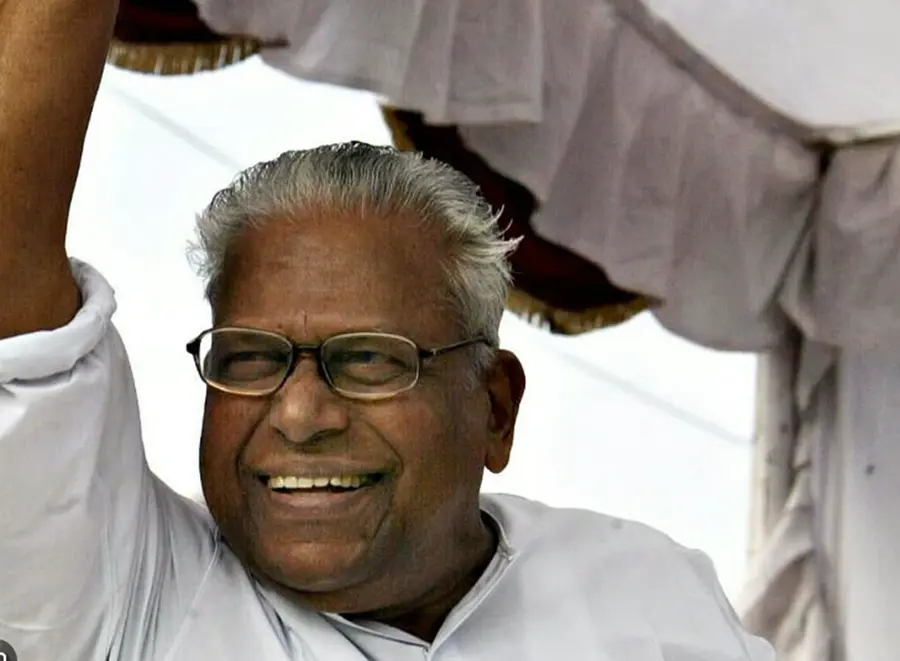
Left for Dead, Life Found Again: How a Thief Saved V S Achuthanandan

Web desk
Published on Jul 21, 2025, 09:31 PM | 4 min read
V S Achuthanandan was at the forefront of the legendary Punnapra-Vayalar uprising. What began as a workers’ agitation for fair wages and employment soon became part of the Communist Party's broader goal: to end the autocratic rule of the Diwan in Travancore. At the time, Diwan Sir C P Ramaswami Iyer had unleashed a reign of terror across the Ambalapuzha–Cherthala region. Even women were not spared from abuse. It was in this context that the Party appointed V S, along with P K Chandranandan, M T Chandrasenan, and M K Sukumaran, to prepare workers to resist the Diwan's police and army. Veterans like V K Karunakaran, who had returned from the army, prepared training grounds and weapons like spears.
As part of the Punnapra-Vayalar struggle, the first clash with police took place in Punnapra, where three worker camps operated: the Panakkal camp, the Velikkakath camp, and the Vadaykkal camp, all under the charge of V S. On October 24, 1946, workers from these camps marched to the Punnapra police camp. A violent confrontation followed, and police opened fire, killing many workers. During the clash, a sub-inspector named Velayudhan Nadar was also killed. After that, the police unleashed widespread violence in the Punnapra region.
Following the Party's directive not to surrender under any circumstances, V S went into hiding, carrying a letter from K V Pathrose. He travelled to Kottayam and met C S Gopalapillai, the Communist Party Secretary there. As advised, he moved to Poonjar and took refuge in the house of Valanickal Ittundan Sahadevan. But political rivals tipped off the police. They surrounded the house and arrested V S.
He was first taken to a local police outpost, then to the Pala police lock-up, where he was brutally tortured under the supervision of SI Idiyan Narayanapilla. The police demanded to know the whereabouts of P Krishna Pillai, E M S, and K V Pathrose. V S, though severely beaten, revealed nothing.
Frustrated, the police laid him flat with his feet sticking out of the lock-up window. His hands were tied, and he was beaten with sticks and coir ropes dipped in cold water. Still, V S kept his silence. In rage, one officer stabbed his right thigh with a bayonet. Blood flowed both inside and outside the lock-up. Eventually, he lost consciousness and stopped breathing. The police presumed he had died.
Since there was no official record of his arrest, they decided to dispose of the "body" secretly. They untied his legs, lifted the "corpse," and laid it beneath a jeep seat. His mundu (dhoti) was removed and used to tie his body. Accompanying them in the jeep was a thief named Kolappan, who was also in custody. The plan was to dump the body in the forest.
During the ride, Kolappan realized V S was still breathing, he wasn’t dead. He alerted the officers, and they rushed him to Pala hospital. V S underwent treatment for weeks.
Meanwhile, a separate arrest warrant had already been issued for V S for speaking at an anti-government meeting in Alappuzha. The police came to the hospital, arrested him, and transferred him to Alappuzha sub-jail. Later, he was shifted with other accused to the Poojappura Central Jail in Thiruvananthapuram. He was registered there as prisoner number 8957. After serving various sentences, he was released in March 1949.
His next imprisonment came during the 1962 India–China war. Although the war began on October 20 and ended on November 21 that year, V S was jailed for a full year. He spent only ten days in Poojappura Central Jail; the rest of the time, he was held at Viyyur Central Jail.
His third jail term came during the Emergency. Three months after the Emergency was declared, V S was arrested and remained in prison for its entire duration.
Thus, in the early decades of his public life, V S spent nearly five years behind bars and four and a half years underground. Whether imprisoned or in hiding, his life proved that struggle knew no pause.



Related News
Dont Miss it





0 comments