
Kerala Must Stand Against Applauding Foreign Aggression: Dr. T M Thomas Isaac

Web desk
Published on Jan 06, 2026, 08:52 PM | 4 min read
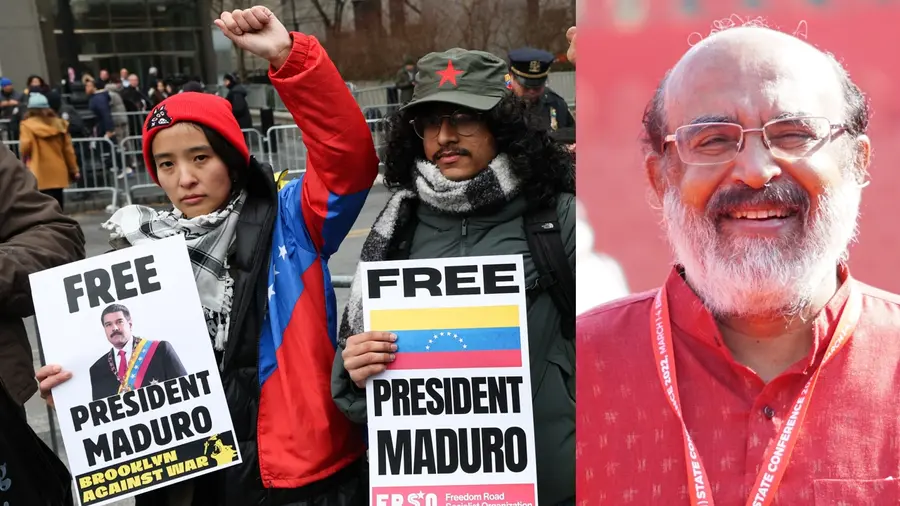
Thiruvananthapuram: CPI M Central Committee Member T M Thomas Isaac has criticised a section of Malayalis who are celebrating former US President Donald Trump’s recent intervention in Venezuela.
In a Facebook post, Isaac said that many social media users are sharing videos and images portraying Nicolás Maduro’s fall as a cause for celebration, despite the ongoing political and economic turmoil in the country. He pointed out that the majority of such posts come from religiously motivated accounts, particularly Christian groups, which often share identical and coordinated content.
Isaac cited offbeatsconcerns.com, which notes that these accounts constitute a significant online presence. He suggested that their lack of similar enthusiasm for Indian Prime Minister Narendra Modi indicates a selective political bias.
Isaac questioned why some Malayalis are supporting Trump while ridiculing Venezuela, highlighting that many of the videos glorifying Maduro’s fall are similar to celebrations by those who left the country during Chávez’s tenure. Even Venezuela’s opposition criticises Trump’s actions, with only 22 percent of Venezuelans supporting foreign intervention according to post-coup opinion polls. Isaac also noted that in the United States, 47 percent of citizens oppose Trump’s intervention, while 21 percent support it.
Some Christian social media users have justified their support for Trump, claiming that he removed a leader who harassed the Catholic Church, allowed drug cartels to operate, and followed leftist policies. Isaac cited the Vatican’s position, where Pope Leo XIII, in a January 4 statement on the Vatican website, emphasised that Venezuela’s developments must be viewed with great concern, and that force must not be used, national sovereignty must be respected, and constitutional and legal norms upheld.
Isaac also addressed claims that Venezuela’s economic collapse was solely the result of communist rule. He explained that until the late 1970s, Venezuela’s oil wealth was almost entirely controlled by US companies, and although it had one of the highest per capita incomes in South America, much of the revenue flowed abroad.
When Hugo Chávez came to power in 1999, he insisted that state control and oversight of private enterprises be implemented to use oil revenue for national development. As a result, Venezuela’s national income grew from 100 billion dollars in 1999 to 400 billion dollars in 2019. Economic decline followed due to US sanctions that disrupted oil trade, and the 2020 COVID pandemic reduced national income back to 100 billion dollars.
Isaac said such unprecedented economic collapse caused by sanctions is now being celebrated online by Trump supporters and global figures like Elon Musk, often through memes, while ignoring the resilience of Venezuelans under revolutionary governance.
Isaac added that under the leadership of Hugo Chávez, Venezuela saw significant social progress. Social welfare spending as a share of GDP rose from 11 percent in 1998 to 22 percent in 2011. Poverty fell from 55 percent in 2003 to 23 percent in 2017, while extreme poverty dropped from 25 percent in 2003 to 7 percent in 2013. Inequality, measured by the Gini index, declined from 0.49 in 1999 to 0.39 in 2013, the lowest in Latin America. The country achieved universal literacy, higher education enrolment doubled, hunger was halved according to FAO, the Human Development Index reached 0.78, and unemployment fell from 16 percent in 1999 to 8 percent in 2013.
Isaac warned that the United States’ sanctions were aimed at undermining Venezuela’s social and economic progress, and that the resulting crisis has now escalated into a coup. He said Kerala must reject those who celebrate such interventions, noting that in doing so, they are not only targeting Venezuela but indirectly ridiculing Kerala’s own efforts to build a progressive and welfare-oriented society. Kerala, he stressed, is attempting to create a new model of development and social justice, inspired by Chávez’s vision, even if it is not identical to Venezuela.



Related News
Dont Miss it







0 comments