
World Music Day, Brought To You By A Skip Button

Rahna Mariyam
Published on Jun 21, 2026, 02:40 PM | 7 min read
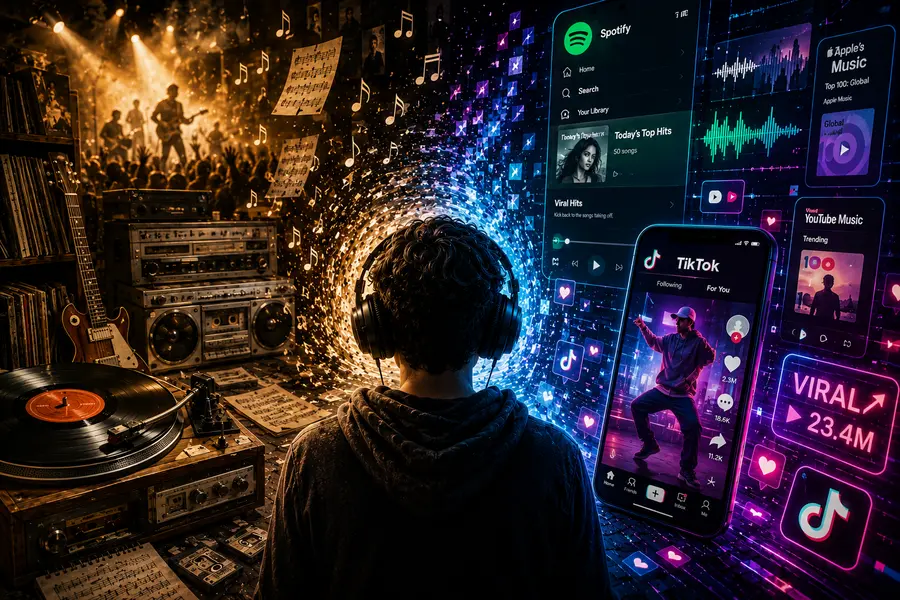
Forty-four years on, World Music Day rolls around again — and somewhere between the confetti and the Spotify Wrapped nostalgia, the songs themselves have quietly shrunk. Not metaphorically. Literally.
In 1982, a pop song's average intro lasted over 15 seconds. Today? Just five seconds. One-third of what it used to be. In 1995 (biased to the year I was born), the average pop song ran 3:50 minutes. In 2026? Under three minutes, with many clocking in at under 2:30.
This change didn't happen overnight. No artist woke up one morning and decided the bridge was overrated. The culprit, instead, sits quietly in the backend of an app most of us check more often than we check on our friends.
Thirty Seconds To Make It Or Break It
Music streaming platforms like spotify counts a stream only after a listener crosses the 30-second mark. That one rule has rewritten the architecture of pop music. Producers no longer ask whether a song is good. They ask whether it survives the first half-minute.
So the slow build is gone. The instrumental intro that once let a song breathe before the first verse arrived? Edited out. Vocals now show up the moment the track starts like the song "Chanel" by Tyla. The song does not waste a second before jumping into the catchy beat and vocals because every second of silence is a second closer to someone hitting "skip."
Bridges have been trimmed to the bone. Second choruses arrive faster. Extended instrumental sections — the parts that used to let a song actually be a song — get minimised because they don't "grab" anyone's attention. And across pop, hip-hop, R&B, K-pop and EDM, the average runtime keeps sliding downward, one algorithmic nudge at a time.
Ten Seconds On TikTok, A Lifetime In The Charts
Platforms like Tiktok and Instagram sure have helped popularise regional music or music from different language and cultures among international audience, creating a global stage and platform so upcoming artists has a fair chance and access to global audience. But on the other hand, they have definitely changed the way music is made or consumed.
If Spotify's 30-second rule is the slow strangulation, TikTok and Instagram are the lethal injection. A ten-second clip on these social media platforms can now decide whether a song becomes a global hit or disappears into the void — and music labels have rearranged their entire creative process around that ten-second window.
The studio conversation has changed. Most people are not asking "is this a great song" anymore. They're asking if the first fifteen seconds has the potential to go viral. The chorus — once the emotional payoff a listener earned after a minute or two of build-up — now shows up almost immediately, because waiting is no longer something listeners are willing to do. The old structure of intro-verse-chorus-verse-chorus-bridge-chorus has been flattened into something closer to hook-verse-chorus-verse-chorus-maybe a bridge-chorus-done.
When The Algorithm Prefers What It Already Knows
Here's the uncomfortable part: streaming platforms don't actually reward boldness. They reward familiarity. The recommendation engine behaves less like a curious listener and more like a cautious radio programmer — repeating what already works, nudging artists toward the safe choice over the daring one. That's a large part of why so much music released today sounds, frankly, like it's already been released before. Platforms like spotify and apple music forced artists to make more music which ultimately sounds like they are made from teh same mould and pushes the music listeners to only accept things that comes from that mould.
Short songs get streamed more. Streamed songs get recommended more. Recommended songs get trimmed even further to fit the next cycle. It's a loop that doesn't ask anyone's permission — it just runs, quietly reshaping the music taste in the background.
Every shortcut comes with a cost, and this one's cost is the emotional architecture of music itself. What's left is music engineered to be skimmed, not sat with. Streams over sentiment. Metrics over meaning. Brief chart success over longevity. Casual listening over emotional connection.
And yet the industry isn't conflicted about it. Most labels aren't asking artists what they want to make anymore — they're asking what the algorithm is likely to push next. That's not a creative brief. That's a spreadsheet with a melody attached.
Art Or Algorithm — Pick One
This leaves musicians with a fairly brutal choice. Write for the algorithm, and the streams come, the charts respond, the label stays happy. Write for yourself, and you risk being talented, original, and completely invisible.
Throw in the now-constant demand to also be a content creator — posting, trending, competing with AI-generated tracks for the same six seconds of attention — and it's no wonder artists today look less like musicians and more like overworked marketing teams who also happen to sing.
Because that's really what it comes down to: your thumb, hovering over the "For You" feed, deciding a song's fate in under three seconds. If it doesn't hook you instantly, you swipe. And somewhere in a studio, a producer who knows this is already cutting the intro a little shorter, just to make sure you don't skip their song the next time.
Of course, not every artist is quietly accepting the algorithm's terms. A few of the biggest names in the room have said, in so many words, that they'd rather not.
Doechii has been one of the loudest about it. The Grammy-winning rapper has made it clear that she is "not here to serve the algorithm." In an interview with The Forty Five, Doechii said, “I’m not really embracing the popularised formula of hits because I found that that agenda, that formula, doesn’t necessarily work for an artist like me.”
“I’m not against hits. Everybody wants hits, and I’m proud of my hits, and I know I have more to come, but it’s more so about breaking out of this formula of what a hit should be and how hits have to sound like this. That’s the part that I’m challenging in music right now,” she told The Forty Five.
"I don't want hip-hop or art to get distracted and lost in trying to make music for a computer," she told The Forty Five — pointing out, rightly, that it's people consuming the music, even if a machine decides who gets to hear it first.
RM of BTS approaches the same tension from a quieter angle. He's admitted to Rolling Stone that he genuinely enjoys checking the Top 50 Global charts — sometimes purely to switch his brain off and consume pop the way everyone else does. But that habit comes with its own discomfort: a recurring feeling that the chart-friendly stuff, however catchy, simply isn't "enough," and that there's more worth digging for underneath it. That instinct shows up directly in his solo albums — both Indigo and Right Place, Wrong Person were built deliberately outside the streaming-optimised mould, leaning into genre-fluid, full-album storytelling rather than the hook-first, three-minute economy everyone else is racing toward.
The algorithm hasn't fully won — artists like Doechii and RM prove that not every artist is willing to let it dictate how they write. Streaming rules and viral trends aren't disappearing anytime soon, but music has outlasted gatekeepers before. Maybe the real World Music Day tribute is simply sitting with a song that takes its time — because, as Jimi Hendrix put it, "we have time, there's no big rush."



Related News
Dont Miss it







0 comments