
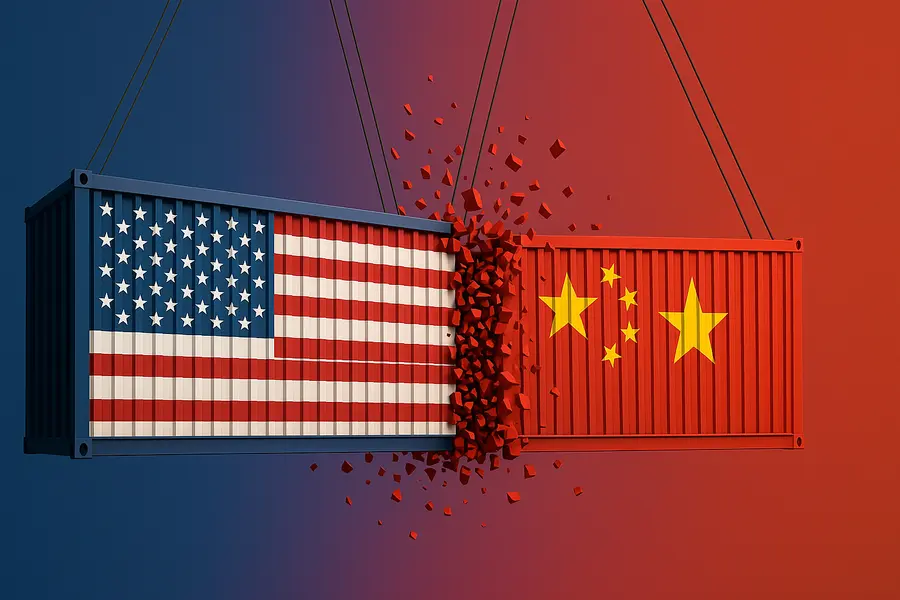
US Slaps 104% Tariffs on China: Escalating Trade War Threatens Global Economy

Web desk
Published on Apr 09, 2025, 12:01 PM | 6 min read
A renewed global trade war is unfolding, once again triggered by the actions of US President Donald Trump. The roots of this conflict trace back to 2018, during Trump’s first term in office, when he began raising tariffs on Chinese goods in an effort to curb what he called unfair trade practices. Now, in 2025, tensions have escalated dramatically. The United States has slapped a staggering 104 percent tariff on Chinese products valued at 438.9 billion dollars. In response, China has imposed retaliatory tariffs on just 48 billion dollars worth of American goods.
Trump’s latest round of tariffs started at midnight Wednesday. Along with the 10 percent baseline tax that began earlier, higher tariffs are now in place on dozens of countries and territories. Some of these are America’s closest allies—countries like Canada, the United Kingdom, Japan, and South Korea. At first, these allies clapped when Trump talked about restoring trade balance with reciprocal tariffs. But now they find themselves caught in the middle too.
Some of the harshest tariffs are hitting small economies. For example, Lesotho faces a 50 percent import tax, Madagascar 47 percent, Vietnam 46 percent, Taiwan 32 percent, South Korea 25 percent, Japan 24 percent, and the European Union 20 percent.
Many critics say this is just a broader form of imperialism, with the US acting like a global dictator trying to control world trade. But this move could backfire. The US is deeply connected to the global economy, and when other countries face economic trouble, it often hits America too. Higher tariffs mean more expensive imports, and that cost is passed down to American consumers. Inflation may be just around the corner. Trump keeps saying that this will encourage businesses to set up shop in the US, create jobs, and help the American economy grow. But experts say this is just wishful thinking. The reality is that these tariffs may drive companies away, raise prices, and hurt the same people Trump says he’s trying to help.
Cracks in the Global Economic System
Trump’s aggressive trade actions have shaken the global economic order. By placing tariffs on so many countries, he has panicked financial markets and raised the risk of a global recession. Many of the alliances that kept the world stable for trade after World War II are now breaking down.
What’s confusing to economists is why Trump is making these changes now. He inherited a strong economy—one of the best in the world. And yet, he’s choosing to tear apart the very system that helped it grow. Eswar Prasad, a trade policy professor at Cornell University, says these tariffs might end America's successful economic run and hurt the job market and stock prices.
Trump and his team say that trade rules have put the US at a disadvantage. They accuse other countries of blocking US exports, manipulating currency, and subsidising their own industries to out compete America. Trump believes the US has been robbed for decades by countries like China, Europe, Mexico, Japan, and even Canada.
He argues that high trade deficits prove this. In 2024, the US trade deficit in goods and services reached 918 billion dollars—the second -highest ever. His adviser, Peter Navarro, calls this deficit “the sum of all cheating” by other nations.
But mainstream economists strongly disagree. They say Trump has a distorted view of trade. Trade deficits, they argue, do not mean a country is losing. In fact, the US has run trade deficits for over 50 years, yet the economy has nearly quadrupled in size during that time. Former IMF chief economist Maurice Obstfeld explains that a bigger trade deficit doesn’t mean lower growth. If anything, the opposite is often true.
Even though countries like China and India have grown quickly, US living standards remain far higher. Yes, American factories closed, and jobs were lost after China joined the WTO in 2001, but much of that was also due to automation. Machines and robots replaced human workers, and that played just as big a role as foreign imports.
High Stakes, Uncertain Future
To reverse this decline in manufacturing, Trump has made tariffs his go-to solution. He’s slapped 25 percent taxes on foreign cars, steel, and aluminum. Chinese goods got a 20 percent tariff, and that was increased by 34 percent, with another 50 percent threatened. He’s added a 10 percent baseline tariff on almost all imports and set higher “reciprocal” rates for countries that the Trump team sees as unfair traders.
These include even tiny economies like Lesotho, along with China and many US allies. Trump believes these tariffs will protect US industries, bring jobs back, raise government revenue, and give him leverage on issues beyond trade—like immigration and drug trafficking.
He says the US has been taken advantage of because it buys more from other countries than it sells. But economists point out that the US is still a trade giant. In 2023, it exported 3.1 trillion dollars in goods and services—second only to China and well ahead of Germany. The IMF forecasted that the US would grow faster than any other major developed economy this year.
The trade deficit doesn’t mean the US is weak. It simply reflects the fact that Americans spend more than they save. When the economy grows, people buy more—including imports. That widens the trade gap. Economists say if the US really wants to reduce its trade deficit, it needs to increase savings and cut government spending. It’s not about being cheated—it’s about how the economy functions.
There’s another side to the trade deficit too. Because the US imports so much, foreign countries invest their earnings back into America. In 2023, the US received 349 billion dollars in foreign investment—more than any other country and nearly double what Singapore received.
But tariffs could scare away that investment. Economist Barry Eichengreen says the only way tariffs would reduce the trade deficit is if they caused investment in the US to crash. That would be a disaster.
Some experts say tariffs can help if they’re part of a smart industrial policy. Harvard economist Dani Rodrik believes well-designed tariffs could encourage manufacturing growth. But Trump’s broad, unpredictable approach does the opposite. It creates confusion, damages relationships with allies, and causes investors to worry.
In the end, Trump’s trade war is a big gamble. It could hurt the economy he claims to protect. And instead of making America stronger, it might leave the country more isolated and economically unstable.



Related News
Dont Miss it









0 comments