
Trump’s Strategic Gambit: Greenland, Venezuela, and New Era of US Assertiveness

Rahna Mariyam
Published on Jan 10, 2026, 01:58 PM | 6 min read
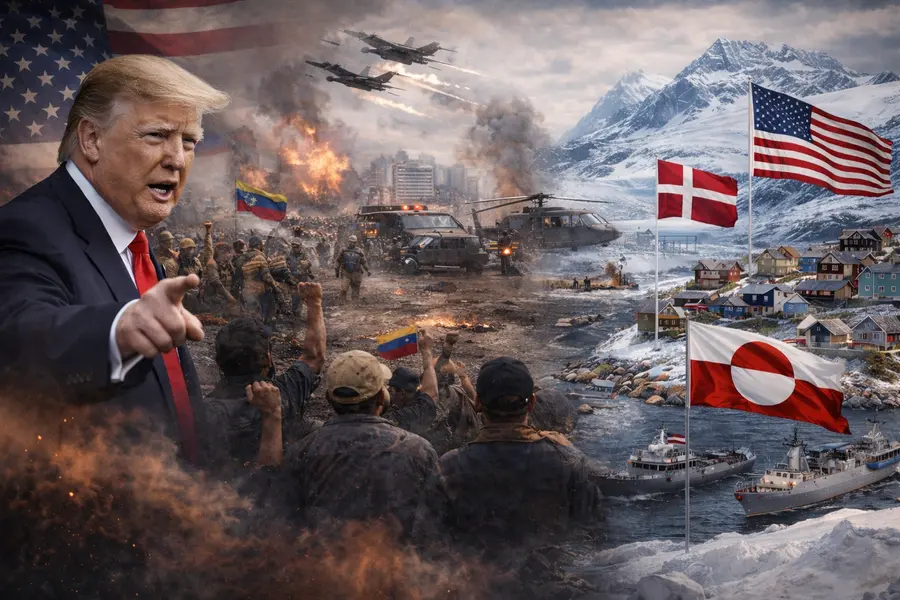
In a startling escalation of United States' new foreign policy rhetoric and action, President Donald Trump has intertwined two seemingly disparate objectives — military intervention in Venezuela and a renewed push to acquire Greenland — into what some analysts are calling a bold, if controversial, bid to reassert American global power.
From Caracas to Nuuk: A Pattern of Assertive Moves
The catalyst for this broader strategic narrative was a military operation in Venezuela in early January 2026, in which American military forces captured fVenezuelan President Nicolas Maduro. The mission was followed by explicit threats against the Venezuelan interim leadership, signalling that Washington’s involvement in Caracas is far from over — even with Maduro detained in US custody. Trump warned Venezuela’s leaders that they face a “fate worse than Maduro’s” should they fail to align with US demands.
The US President's threats did not stop there. Following Venezuelan attack, he threatened fellow Latin american countries like Colombia, Cuba and Mexico.
Within days, emboldened by the Venezuelan intervention, Trump pivoted northward, reviving his long‑standing interest in Greenland — a Danish-owned, self-governing territory— by declaring that the United States will acquire the island “by any means necessary.” He has framed this goal as a national security imperative, arguing that the Arctic territory is vital to countering influence from Russia and China in the region, underscoring Greenland's strategic vantage point.
During one of his interviews to The Atlantic, Trump said," We do need Greenland, absolutely. we need it for defence."
White House officials have gone further, openly discussing options that include the possible use of military force to secure control over Greenland, even as Denmark and Greenland openly criticised the idea.
Underscoring Trump's move, White House Deputy Chief of Staff Stephen Miller said, "It has been the formal position of the US government since the beginning of this administration that Greenland should be part of the United States."
Risking NATO Unity
Greenland’s status under the Danish government gives it indirect membership in the North Atlantic Treaty Organization (NATO), and leaders of the alliance have reacted with alarm. Denmark’s prime minister has said that any US attempt to unilaterally seize Greenland would effectively spell the end of the NATO alliance, warning that such actions would break the bloc.
While criticising the American President's threat, Danish Prime Minister Mette Frederikson told media that "unfortunately, I think the American President should be taken seriously when he says he wants Greenland."
Italian Prime Minister Giorgia Meloni, despite being an ally of Trump, publicly ruled out military annexation and stressed the need for strengthened NATO cooperation in the Arctic instead.
European capitals have also rallied in support of Danish sovereignty, with the UK’s prime minister and German officials asserting that decisions about Greenland’s future must be determined by Denmark and Greenland themselves.
As per political analysts, this move could ultimately end the NATO alliance. If Trump makes a move to attack another NATO member, that would result in the breach of Article 5 of the NATO', which states that an attack on one member nation is an attack on all.
Strategic Stakes in the Arctic
Greenland has become a critical strategic asset in the growing competition between the United States, China, and Russia. Positioned between North America and Europe, Greenland holds a strategic vantage point as the territory anchors the Greenlad-Iceland-UK gap, a key corridor for military and naval movement between the Arctic and the Atlantic.
As per expert opinions, Greenland is central to United States as it is central to missile early warning systems while help detect potential threats from Russia. The control and access to the Arctic territory will strengthen the US defence and deterrence capabilities.
The region is also rich in critical minerals, including rare earths and uranium, which are essential to advanced technologies and strategic supply chains.
As climate change opens the Arctic to increased navigation and resource access, Greenland’s role as a military, economic, and geopolitical vantage point will only grow—making it a quiet but decisive factor in global power competition.
Trump argued that the US “needs Greenland” for defence purposes and has downplayed the necessity of negotiating with Denmark, dismissing purchase proposals and suggesting that territorial control must be secured regardless of local consent.
Implications for International Law and Global Order
A forced acquisition of Greenland would challenge the international laws against territorial intervention. Unlike the US’s operation in Venezuela — which the administration justified under its own doctrine of hemispheric influence, and the so called "human rights violations" in the country — annexing territory from a fellow NATO member, without any provocation, touches the core of international legal commitments.
Danish and Greenlandic leaders have responded with stark condemnation, asserting that Greenland is “not for sale” and urging respect for sovereignty and international law.
Responding to United States' threat of annexation, China framed the US rhetoric as a violation of international norms and a threat to the sovereignty of the Kingdom of Denmark. They also denied Trump's claims that Greenland is covered with Russian and Chinese ships.
A New Doctrine of Global Pressure?
Analysts are placing these developments in the context of what Trump himself have dubbed the “Donroe Doctrine” — a contemporary twist on the 19th‑century Monroe Doctrine, indicating a policy of extending America's influence across the Western Hemisphere. Under this proposed policy, sovereignty of an independent territory is worth being risked if it could serve the purpose of national security objectives of Trump and MAGA.
This approach, critics warn, could set dangerous precedents: from heavy‑handed military interventions in sovereign states like Venezuela to coercive pressure on allies over territories like Greenland. It also raises questions about what alliances like NATO mean when one major power threatens another’s territorial integrity. Besides, US's move could embolden the ideas of countries like Russia and China, who are eyeing on the total control countries like Ukraine and Taiwan.
Broader Global Repercussions
If Trump decides to annex Greenland, a territory falling under one of the NATO allies, trust between Washington and its European allies could erode sharply, prompting the partners to reconsider their security dependencies, which could lead to the end of NATO.
Additionally, attempts by other global powers, who had been continuously trying to increase their presence in the Arctic, could exploit the diplomatic fracture, further complicating a region already marked by competitive military and commercial interests.
Moreover, If a major power moves to seize territory from an ally, it could embolden other revisionist states, undermining norms of sovereignty and territorial integrity.
Trump’s focus on Venezuela and Greenland — military intervention in the former and aggressive territorial ambition toward the latter — represents a dramatic flex in US foreign policy. While Trump supporters argue it reflects decisive leadership and strategic foresight by the Republican President, opponents see it as a repudiation of the international order that has maintained global stability for decades.
At stake is not merely the fate of Venezuela or the future of the Greenland, but the credibility of alliances, the strength of collective defence commitments, and ultimately, the sovereignty of nations.



Related News
Dont Miss it








0 comments