
Trump’s 50% Tariff Push Threatens Indian Exports, Kerala Hit Hardest

Anjali Ganga
Published on Aug 08, 2025, 01:45 PM | 4 min read
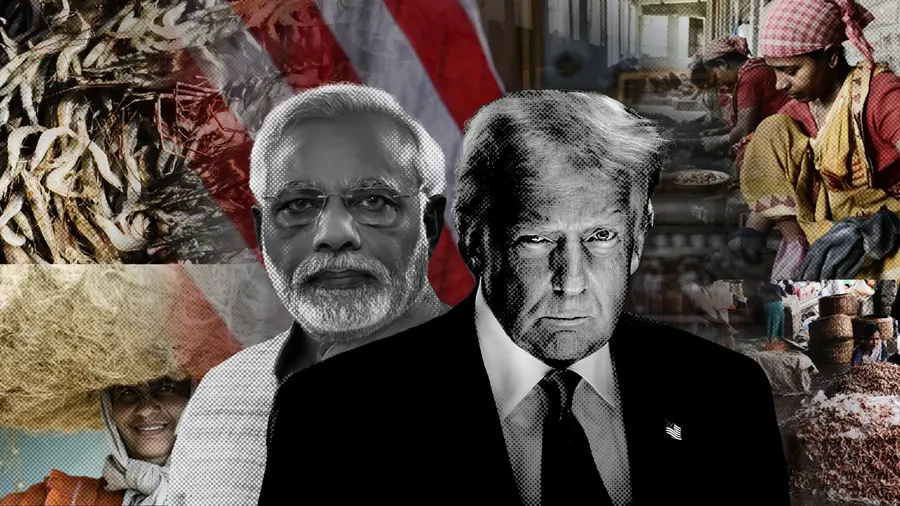
Thiruvananthapuram: In a move that has sent shockwaves through India’s export economy, US President Donald Trump has announced a steep 50 percent tariff on a wide range of Indian goods. As the United States remains India’s largest trading partner, this decision is expected to inflict widespread disruption across key export sectors, with Kerala set to suffer the most severe blow.
In the financial year 2024–25, trade between India and the US reached 11.47 lakh crore rupees, of which 7.53 lakh crore rupees came from Indian exports. With imports from the US standing at 3.94 lakh crore rupees, India maintained a trade surplus of 3.58 lakh crore rupees. The new tariff regime threatens to reverse this dynamic, shrinking export volumes and straining trade relations.
The impact will be most pronounced in industries such as textiles, jewellery and precious stones, leather goods and footwear, marine products, chemicals, pharmaceuticals, machinery, electronics, electrical equipment, and petroleum. Many of these sectors already face stiff competition from countries like China, Vietnam, Malaysia, Thailand, Mexico, Bangladesh, and Canada, all of which enjoy lower tariffs in the US. India–US trade in textiles alone accounts for 1 lakh crore rupees annually, with the new tariff raising duties on fabrics to 59 percent. Trade in jewellery and precious stones is of similar value. Other major segments facing setbacks include leather and footwear (10,266 crore rupees), chemicals (20,358 crore rupees), marine products (20,000 crore rupees), and electrical machinery (78,300 crore rupees).
Kerala, a major contributor to India's exports, is set to be disproportionately affected. Key export items from the state, such as marine products, coir, cashew, and spices, are among those subjected to the harsh tariff increase. Despite India facing the highest tariff burden among Asian nations, Prime Minister Narendra Modi’s administration has yet to mount a strong response, drawing criticism for perceived subservience to the US.
Big Setback for Kerala’s Exports
Among Kerala’s exports, seafood stands out as the most vulnerable. In 2024–25, the state exported marine products worth 7,000 crore rupees, with over 40 percent destined for the US. Around 90 percent of these exports are shrimp, most of which come from the Kochi region. The new US tariff on Indian marine products now stands at 67.7 percent. Competing countries like Ecuador (10 percent), Vietnam (20 percent), and Indonesia (19 percent) now have a competitive edge, threatening to wipe out India’s presence in the US seafood market. The situation has already led to cancellation of orders, halted shipments, and stranded inventory, some of it 70 to 100 percent completed. Exporters and traders who had made advance investments are now facing mounting losses. A collapse in this sector would ripple through coastal communities and allied industries across the state.
Kerala’s iconic coir industry, which includes over 60 export enterprises and 560 production units, is also under threat. With the cost of exports rising sharply, businesses fear that synthetic substitutes from other countries may permanently displace Indian coir in US markets. A meeting between industry representatives, trade unions, and Industries Minister P Rajeeve is being planned to address the crisis. Exporters say they managed earlier losses by sharing costs with US importers when tariffs were at 25 percent, but a 50 percent hike is unsustainable. If exports halt, synthetic products will take over and potentially lock India out of the market permanently.
Kerala’s cashew industry, already struggling with competition from Vietnam, now faces indirect fallout. Though only three percent of Indian cashew exports currently reach the US, the new tariff could shift Vietnam’s focus toward Indian and Gulf markets, potentially undercutting India’s position there as well. While India’s hand-processed cashew retains its quality advantage, production costs are higher compared to mechanised rivals. If Vietnamese cashew reaches Gulf markets at lower prices, India’s dominance may erode.
Spice exports are another casualty. Last year, India exported 17.99 lakh tons of spices worth 39,994 crore rupees, with Kerala contributing around 600 crore rupees. The US is a major importer of key spices like cardamom, black pepper, cinnamon, nutmeg, and turmeric. Exporters and US importers had earlier agreed to share the burden of a 25 percent tariff, but a 50 percent rate is untenable. The resulting price hike will dampen US consumer demand, severely impacting both manufacturers and farmers in Kerala. For value-added spice companies based in the state, this could mean a drastic fall in production and revenue.
With Trump’s tariff hike threatening every major export from Kerala, the state stands on the brink of an economic crisis. From seafood processors along the coast to spice growers in the high ranges, the blow is deep and wide. Without urgent national intervention and strategic policy support, the damage to Kerala’s economy could be long-lasting.



Related News
Dont Miss it










0 comments