
Israel strike escalates as Netanyahu resists hostage deal
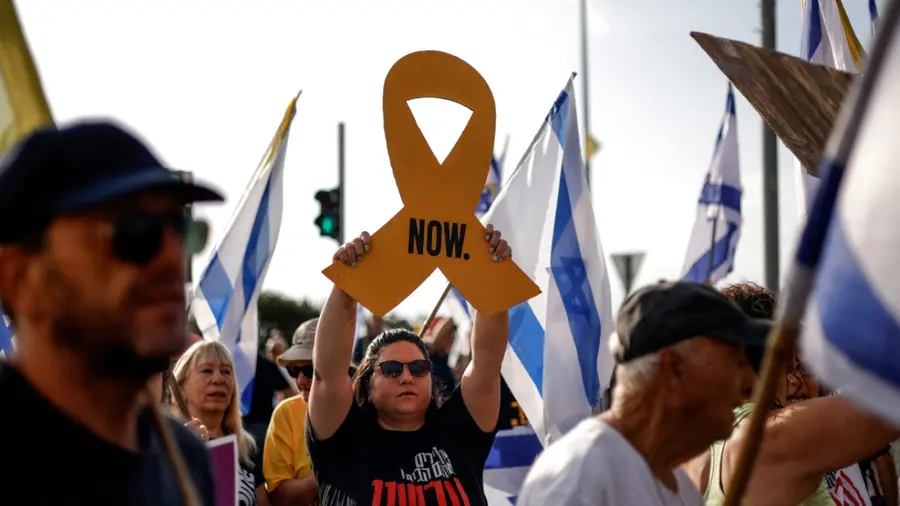
An Israeli woman raises a cutout of a yello ribbon as others wave national flags, during an anti-government protest demanding a deal to release Israeli hostages held in the Gaza Strip by Hamas militants since October 7, 2023, near the northern town Kiryat Shmona on August 17, 2025 Demonstrators took to the streets across Israel on August 17, 2025, more than a week after Israel's security cabinet approved plans to capture Gaza City and nearby camps, following 22 months of war that have created dire humanitarian conditions. (Photo by Jalaa MAREY / AFP)

Web desk
Published on Aug 17, 2025, 06:22 PM | 3 min read
Jerusalem: Protesters across Israel staged a nationwide strike on Sunday, demanding that Prime Minister Benjamin Netanyahu’s government agree to a ceasefire and secure the release of hostages held in Gaza. The strike, dubbed a “day of stoppage,” shut down businesses, blocked highways, and intensified the growing confrontation between hostage families and an increasingly embattled government.
The campaign, led by families of hostages and bereaved relatives, came just weeks after militant groups released videos of captives and Israel signalled plans for yet another offensive in Gaza. Protesters fear such military escalation will further endanger the estimated 50 hostages still in captivity, only around 20 of whom are believed to be alive. At demonstrations in Tel Aviv and other cities, protesters carried banners and lit bonfires, chanting: “We don’t win a war over the bodies of hostages.” Police deployed water cannons, made 32 arrests, and clashed with crowds outside politicians’ homes and military headquarters. Several restaurants and theatres joined the strike in solidarity. “Military pressure doesn’t bring hostages back – it only kills them,” said former hostage Arbel Yehoud at a rally in Tel Aviv. Anat Angrest, whose son Matan remains captive, declared: “Today, we stop everything to save and bring back the hostages and soldiers. Today, we stop everything to remember the sanctity of life.” Israel’s largest labour union, Histadrut, ultimately withheld support, but the widespread participation by municipalities and businesses underscored the growing public frustration with Netanyahu’s intransigence. For months, the Prime Minister has rejected hostage-for-ceasefire deals, trapped between public pressure and the threats of far-right allies in his fragile coalition. Ministers Bezalel Smotrich and Itamar Ben-Gvir quickly condemned the strike, branding it a “harmful campaign” that “strengthens Hamas.” Both repeated the government’s refrain that military escalation is the only option, despite mounting evidence that prolonged offensives only deepen the humanitarian catastrophe in Gaza and fail to secure hostages’ release. Netanyahu, haunted by the collapse of his coalition should he negotiate with Hamas, appears unwilling to prioritize the lives of hostages over his own political survival. The last ceasefire agreement that freed hostages nearly cost him his government, as far-right members threatened to topple his rule if Hamas remained in power. Meanwhile, Israel’s war continues to escalate regionally and domestically. On Sunday, Israeli airstrikes hit Yemen’s capital, targeting a power plant in Sanhan that Houthis claim was civilian infrastructure. Israel described it as “energy facilities used by the Houthis” in response to missiles fired toward its territory. Inside Gaza, Israel is preparing for yet another offensive, this time in Gaza City and other dense areas. The military announced plans to allow the UN to import tents and shelters, ahead of mass forced evacuations it claims are meant to protect civilians. Aid organisations, however, accuse Israel of weaponising humanitarian assistance by controlling and limiting its flow. The cost of Netanyahu’s strategy is devastating. Israel’s bombardment and blockade have killed over 61,000 people in Gaza, according to the Health Ministry there, nearly half of them women and children. Most of the territory’s population has been displaced, and UN agencies warn of record levels of starvation. In the past 24 hours alone, seven children died from malnutrition-related causes. The war began with the Hamas-led attack of 2023, which killed about 1,200 people in Israel. But Netanyahu’s response, an open-ended war, collective punishment, and refusal to compromise, has drawn Israel deeper into crisis. Far from securing hostages or weakening Hamas, his policies risk prolonging both the war and his grip on power, even as Israeli society fractures under the weight of grief and anger.



Related News
Dont Miss it








0 comments