
Global Outrage as Israel Passes Discriminatory Death Penalty Law for Palestinians; Rights Groups Call it 'War Crime'
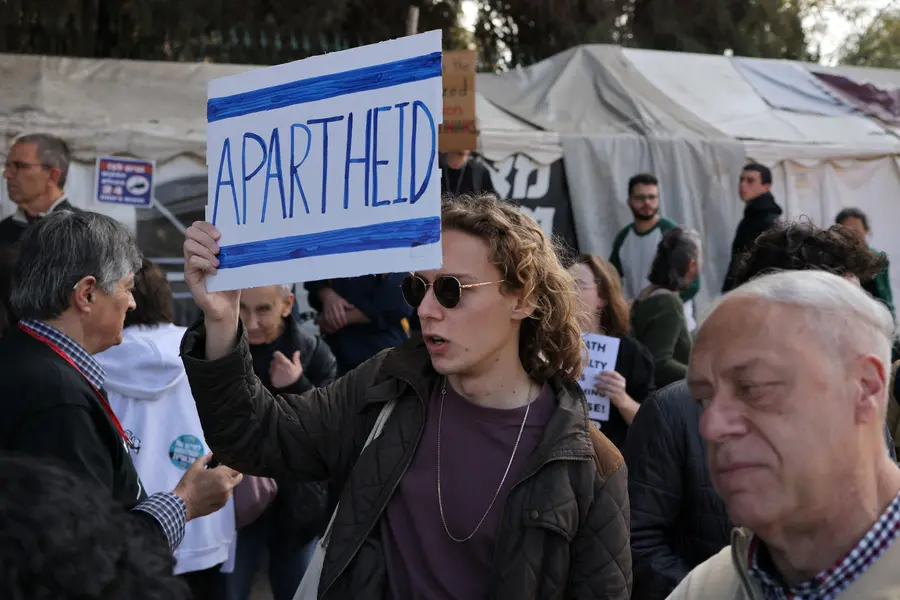
Protesters gather outside the Knesset, the Israeli parliament, in Jerusalem on March 31, 2026, during a demonstration against the passing of a law allowing for the death penalty against Palestinians. (Photo | AFP)
Tel Aviv: A storm of international condemnation has engulfed Israel following the passage of a landmark law that instructs military courts to impose the death penalty on Palestinians convicted of killing Israelis in acts of "terror," while not imposing the same penalty on Israelis convicted of killing Palestinians. The legislation, which cleared the Knesset on Monday, has drawn fierce criticism from human rights organisations, foreign governments, and the United Nations, with many characterising it as a codification of racial discrimination.
Lawmakers voted 62-48 to mandate death by hanging as the default punishment for West Bank residents (excluding Israelis) convicted of deadly terrorist acts by military courts. While judges can opt for life imprisonment under vaguely defined "special circumstances," the death penalty would otherwise be mandatory and be carried out within 90 days of sentencing.
The bill calls for the Israel Prison Service to carry out executions by hanging within 90 days of sentencing, with no right to appeal. The vote marked a culmination of years of lobbying by Israel's far-right wing. The vote marked a major victory for far-right National Security Minister Itamar Ben Gvir, whose Otzma Yehudit party has long championed the legislation and who immediately handed out champagne as members of the coalition celebrated its passage following nearly twelve hours of debate.
Representatives from the Attorney General's office, the Shin Bet, the Foreign Ministry, and the Justice Ministry appeared before the Knesset National Security Committee to express their continued opposition to the bill, underscoring the depth of unease within Israel's own security and legal establishment.
Rights Groups Sound the Alarm
Minutes after the law was passed, the Association of Civil Rights in Israel filed a petition with Israel's Supreme Court challenging it, describing it as "discriminatory by design" and "enacted without legal authority" over West Bank Palestinians. The group also noted that the threshold for imposing the death penalty would be lowered, with courts able to impose sentences of death by hanging by simple majority rather than a unanimous decision by judges.
A coalition of human rights and civil society organisations in Israel condemned the bill as an "official stamp of approval on a policy of vengeance and racist violence against Palestinians," stressing that the law targets Palestinians while exempting Israelis.
Amnesty International linked the new legislation to a broader pattern of impunity. Erika Guevara-Rosas, Amnesty International's senior director of research, advocacy, policy and campaigns, noted that the law's passage came just weeks after Israel dropped all charges against soldiers accused of sexually assaulting a Palestinian detainee, warning that the new law "which allows for state-sanctioned executions is a culmination of such policies."
Human Rights Watch echoed those concerns. "Israeli officials argue that imposing the death penalty is about security, but in reality, it entrenches discrimination and a two-tiered system of justice, both hallmarks of apartheid," said Adam Coogle, the group's deputy Middle East director.
The United Nations issued some of its strongest language yet in response to the legislation. UN Human Rights Chief Volker Turk slammed the approval of the "deeply discriminatory" legislation, saying that the death penalty becoming the default punishment for Palestinians in the occupied territory was "patently inconsistent with Israel's international law obligations," adding that "its application to residents of the occupied Palestinian territory would constitute a war crime."
The UN Human Rights Office in Palestine called on Israel to "immediately repeal the discriminatory death penalty law," noting that "this law further entrenches Israel's violation of the prohibition of racial segregation and apartheid as it will exclusively apply to Palestinians in the occupied West Bank and Israel, who are often convicted after unfair trials."
France, Germany, Italy, and the United Kingdom all raised concerns over what many described as the overtly discriminatory nature of the bill, with their foreign ministries writing in a joint statement that they were "particularly worried about the de facto discriminatory character of the bill" and warning that it risked "undermining Israel's commitments with regards to democratic principles."
Spanish Prime Minister Pedro Sanchez called the legislation "a step towards apartheid," writing that it was "an asymmetrical measure that would not apply to Israelis committing the same crimes. Same crime, different punishment. It's another step towards apartheid. The world cannot stay silent."
Palestinian Response and Protests
Hundreds of Palestinians protested across the occupied West Bank in several cities, including Ramallah, Tubas, Nablus, Jenin, and Hebron, after calls by prisoner advocacy groups. The Palestinian Authority called the bill a war crime, saying it breached the Fourth Geneva Convention, "particularly the protections it guarantees for individuals and the safeguards for fair trials."
The Palestinian Ministry of Foreign Affairs condemned the legislation as a "dangerous escalation," stressing that "Israel has no sovereignty over Palestinian land" in the occupied territory.
The Palestinian Prisoners' Society decribed the bill as "a historic escalation — a new phase of openly sanctioned, politically motivated executions of Palestinian prisoners."



Related News
Dont Miss it









0 comments