
Health - World Bank Loan For Kerala Health System Improvement Programme
World Bank Approves $280 Million Loan for Kerala's Health System Improvement Programme

Image courtesy: Free Press Journal

Anusha Paul
Published on Oct 25, 2025, 11:59 AM | 4 min read
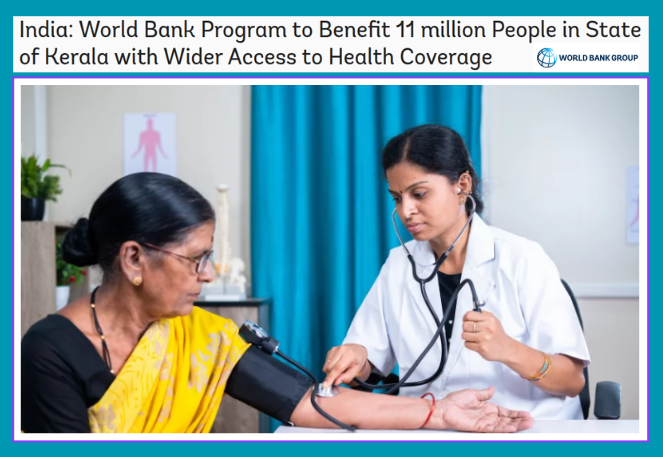
Thiruvananthapuram: On Friday, the World Bank’s Board of Executive Directors approved a $280 million loan for the Kerala Health System Improvement Programme. The programme aims to improve the life expectancy and quality of life for over 11 million elderly and vulnerable people in Kerala by providing better access to healthcare and making the state’s health system more resilient to climate shocks.
Kerala has long been known for its public health success, with significant reductions in neonatal, infant, and maternal mortality over the past two decades. However, the state is now facing a rising burden of non-communicable diseases (NCDs) like hypertension, diabetes, and cancer, along with an ageing population, which is putting considerable pressure on its healthcare infrastructure. The new programme seeks to address these challenges by expanding healthcare access and ensuring more effective management of chronic conditions.
One of the key elements of the Kerala Health System Improvement Programme is the creation of an electronic health tracking system. This will track and treat over 90% of patients registered for hypertension and diabetes. The aim is to ensure more accurate and personalised management of these chronic conditions. Additionally, the programme will introduce a home-based care model for elderly patients who are bedridden, home-bound, or otherwise unable to access traditional healthcare facilities. This initiative is crucial in ensuring that the most vulnerable elderly populations receive proper care at home, especially those who face mobility or transportation challenges.
The programme also focuses on enhancing Kerala’s digital health infrastructure, which includes expanding eHealth services and integrating various health data platforms to improve healthcare delivery. This digital transformation is designed to make healthcare services more efficient and secure in a rapidly evolving technological landscape. Moreover, the programme aims to make health facilities more resilient to climate-related risks, such as extreme heat and flooding. This includes implementing energy-efficient solutions and developing strategies to manage climate impacts, particularly in districts like Wayanad, Kozhikode, and Alappuzha, where such challenges are most acute.
Paul Procee, Acting Country Director for India at the World Bank, said that the programme is expected to lead to a 40% increase in the number of patients whose hypertension is controlled and a 60% rise in breast and cervical cancer screenings for women. These improvements are aimed at reducing premature deaths from treatable conditions. The World Bank’s loan, which comes with a 25-year maturity period and a five-year grace period, signifies long-term support for Kerala’s health sector.
Earlier this year, Kerala established the Kerala State Senior Citizens Commission under the newly passed Kerala Senior Citizens Commission Act, 2025. This Commission, the first of its kind in India, will focus on safeguarding the rights of the elderly and addressing critical issues such as abuse, neglect, and financial insecurity, which are becoming more pronounced as the elderly population grows.
The Commission will be led by K. Somaprasad, who has been appointed as its first chairperson, alongside Amaravila Ramakrishnan, E. M. Radha, K. N. K. Namboothiri, and Lopes Mathew, who will serve as members. The formal inauguration of the Commission took place during a ceremony at the Secretariat, led by R. Bindu, Kerala’s Minister for Higher Education and Social Justice in September.
As Kerala’s elderly population steadily increases—from 13% of the total population in 2011 to 16.5% in 2021—the state is confronting an ageing demographic that is projected to accelerate further in the coming years. By 2030, Kerala is expected to become a "super-aged" society, with over 20% of its population anticipated to be over 60 years of age.
The new Senior Citizens Commission will focus on several critical issues. First, it will advocate for policies and initiatives to prevent abuse and neglect of elderly people, ensuring that their dignity and well-being are respected. The Commission will also address financial neglect by designing policies to ensure that elderly individuals have access to adequate social security, pensions, and care services. In addition, the Commission will support the rehabilitation and welfare of senior citizens, promoting active, healthy, and independent lifestyles. This is particularly important as elderly women in Kerala tend to live longer than men and often face higher levels of vulnerability.
The timing of these initiatives is particularly relevant given that India as a whole is facing an ageing population. A 2023 report from the United Nations Population Fund (UNFPA) predicted that the number of elderly people in India would increase from 149 million in 2022 to 227 million by 2036, and nearly 350 million by 2050. By mid-century, one in every five people in India will be elderly, underscoring the importance of addressing their needs through comprehensive healthcare and social support systems.
Related News
Tags



Related News
Dont Miss it










0 comments