
Health
Kerala’s People-Centric Health System Honoured at Victorian Parliament

Web desk
Published on Jun 21, 2025, 01:38 PM | 4 min read
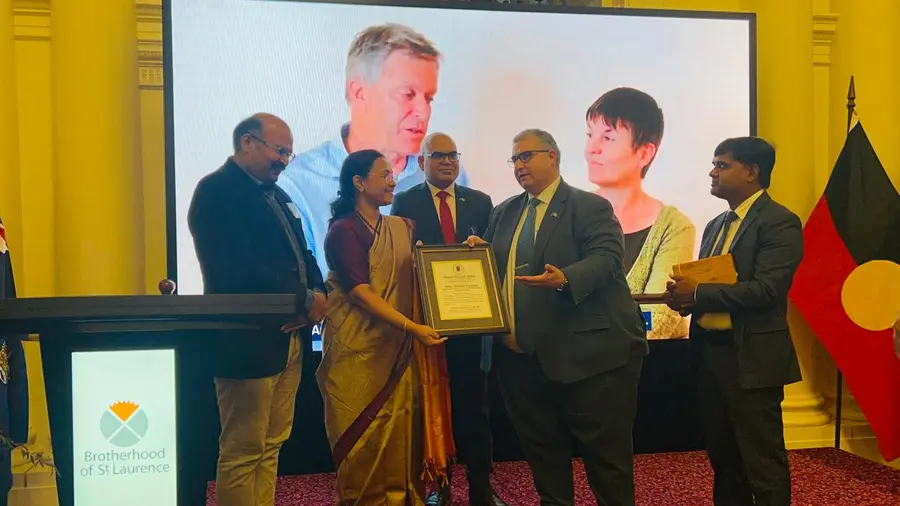
Thiruvananthapuram: Kerala’s Health Minister Veena George was formally honoured at the Parliament of Victoria, Australia, during an official session of the Upper House. The minister was welcomed by Upper House President Shaun Leane and presented with a special award by Government Chief Whip Lee Tarlamis. The event marked a rare instance of a sub-national Indian minister being invited as a special guest to a parliamentary session abroad.
The recognition comes within a larger framework of emerging cooperation between Kerala and the Australian state of Victoria, particularly in the areas of public health systems, policy exchange, and technical collaboration. During her visit, Minister Veena held discussions with Victorian Premier Jacinta Allan, Deputy Premier Ben Carroll, Health Minister Mary-Anne Thomas, and other officials, focusing on knowledge exchange and partnership in healthcare delivery and governance.
Kerala’s public health system is the product of decades-long social policy reforms, public investments and institutional development that distinguish it from much of the Indian context. Long before national-level health missions were rolled out, Kerala had established an effective network of primary health centres (PHCs), community health workers, and district hospitals. These institutions are not standalone entities but function in coordination with panchayats, anganwadis, and public education systems, reflecting an integrated approach to welfare.
Historically, land reforms, high female literacy, and investments in education and public provisioning created the social foundations for this health infrastructure. The People's Plan Campaign of the late 1990s, which deepened decentralisation and participatory governance, further enabled local-level responses to health and sanitation issues. The role of the public distribution system in ensuring food security, alongside housing and sanitation initiatives, has also had long-term effects on public health.
In the past decade, Kerala has continued to build on this legacy while responding to new public health challenges. Under Veena George’s tenure, the Health Department has prioritised expansion in several areas: mental health infrastructure, trauma care, early intervention for children with disabilities and rare diseases, digitisation of health records, and capacity-building for medical personnel.
Kerala's response to the COVID-19 pandemic—particularly in the first and second waves—was widely observed internationally for its early warning systems, daily public communication, use of grassroots health workers, and reliance on scientific expertise. While challenges intensified during subsequent waves, the state maintained a higher testing rate and hospital preparedness compared to national averages. Earlier outbreaks, including the 2018 and 2021 Nipah virus incidents, saw the state adopt containment protocols and interdepartmental coordination that are now being studied by other regions.
The Aardram Mission, a key state initiative, continues to revamp public hospitals through infrastructure modernisation, patient-friendly procedures, and training in compassionate care. Several district and taluk hospitals have been upgraded under this programme to meet the standards of “family health centres,” offering a broader range of services under one roof.
Kerala’s health policy also attempts to address structural inequalities that impact access. Outreach programmes in tribal and coastal areas, targeted maternal care schemes, gender-focused mental health interventions, and mobile health units in remote regions are examples of this approach. Kerala remains one of the few Indian states with publicly funded schemes that cater specifically to trans persons' healthcare, including gender-affirming treatments. In the public health space, this emphasis on inclusion is not framed as charity but as part of a rights-based policy framework.
Government-run institutions such as the Kerala University of Health Sciences, the State Institute of Health and Family Welfare, and various nursing and paramedical training centres continue to support the system through research, training, and human resource development. The honour extended by the Victorian Parliament must be seen in this context—not merely as symbolic recognition, but as an opportunity to engage in mutual learning between two public health systems. While Victoria operates within a more privatised but technologically advanced framework, Kerala offers lessons in equitable access, decentralised planning, and community participation.
Such sub-national partnerships represent a shift in global cooperation models—moving beyond centralised, bilateral diplomacy to more pragmatic, issue-based collaboration between regional governments. In areas like climate resilience, education, and health, these engagements reflect how regional models can shape international discourse. For Kerala, the engagement also signals that its efforts in maintaining a public-oriented, people centric health system continue to find relevance in a global context increasingly questioning market-driven models of care.
As the political discourse in India increasingly gravitates toward privatisation of essential services, Kerala remains one of the few states still investing in the public provisioning of health, education, and social security. While the system is not without strain—especially in terms of fiscal limitations, as the union government continues to defund the state.



Related News
Dont Miss it








0 comments